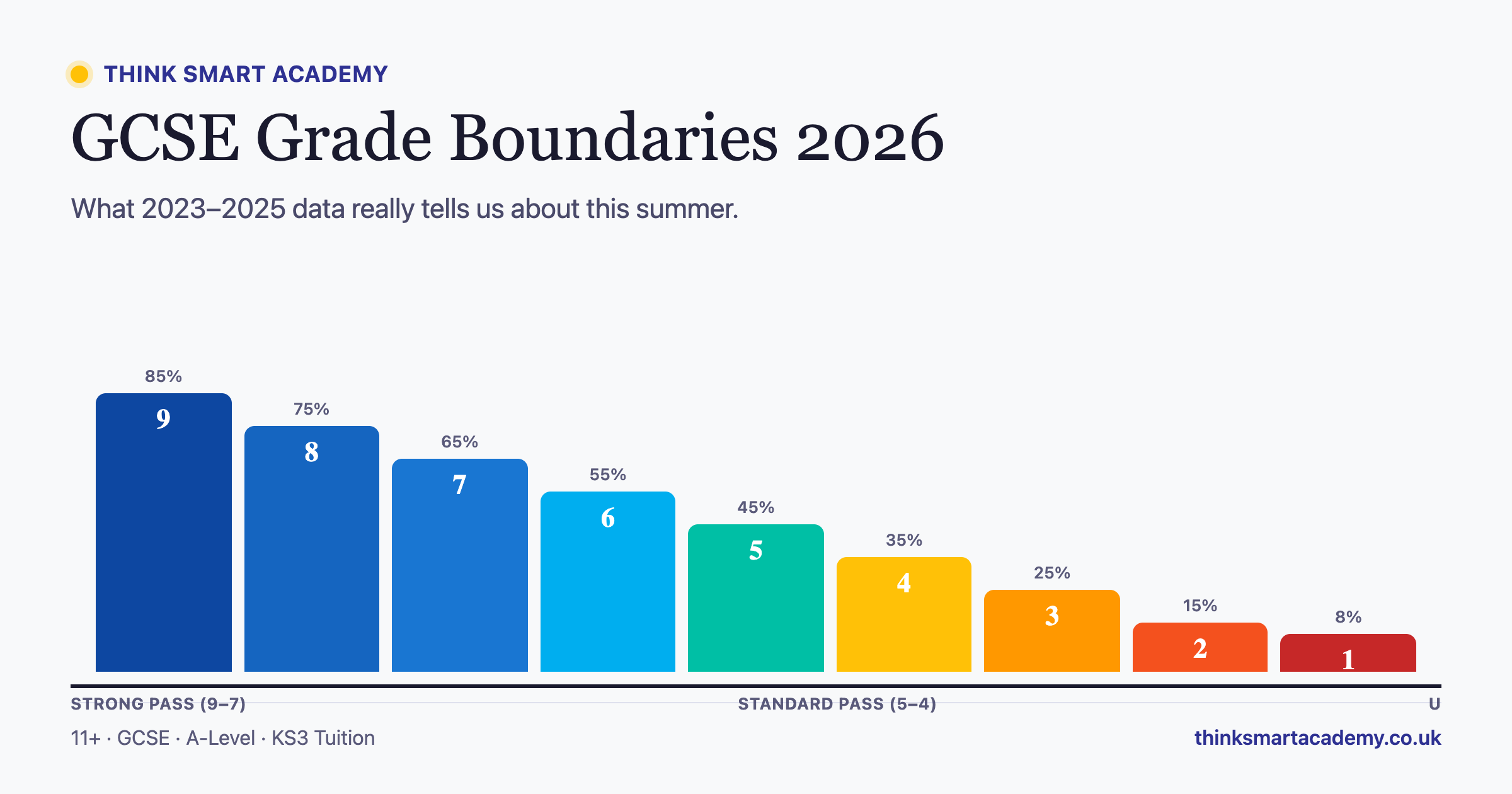
GCSE grade boundaries for 2026 will not be published until Thursday 20 August 2026, the morning of results day. Each exam board (AQA, Edexcel, OCR, WJEC/Eduqas, CCEA) releases its boundaries separately, usually from around 7am. We cannot predict the 2026 boundaries exactly, but three years of historical data (2023, 2024, 2025) show clear patterns, and that is what parents and students should use to estimate where this year’s marks will land.
When Will 2026 Grade Boundaries Be Published?
Grade boundaries are released on results day itself. For summer 2026, that is Thursday 20 August 2026. AQA and Edexcel typically publish their full boundary tables online between 7am and 8am, a couple of hours before students collect results.
Any website or tutor claiming to “predict” exact 2026 boundaries before August is guessing. Ofqual (the regulator) and the exam boards deliberately hold boundaries back until awarding is complete. The reason: boundaries depend on how the whole cohort performed this year, not a formula set in advance.
Parents panic about grade boundaries more than they should. Here is what actually moves them year-to-year, and what past data suggests for 2026.
How Grade Boundaries Actually Work
A few definitions worth having straight before you look at the numbers.
Grade boundary: the minimum raw mark required to achieve a given grade. If the Grade 7 boundary for AQA Higher Maths is 163, a student needs 163 marks out of 240 to get a Grade 7. 162 is a Grade 6.
Raw mark: the actual marks a student scored on their papers, before any scaling. GCSE Maths papers are each out of 80, so three papers give a total of 240 raw marks.
UMS (Uniform Mark Scale): largely obsolete at GCSE. The current 9-1 system uses raw marks directly for subject boundaries. Do not get sidetracked by old A*-G UMS explanations.
Comparable outcomes: Ofqual’s principle that the proportion of students getting each grade should stay roughly stable year-to-year, assuming the cohort’s prior attainment is similar. If this year’s paper was harder, boundaries drop. If it was easier, boundaries rise. The grade distribution is protected; the raw mark needed is not.
Pre-pandemic alignment: 2023 was the year Ofqual returned to pre-2019 grading standards after three years of inflated grading (2020, 2021, 2022). Since 2023, boundaries have been set using the same rigour as 2019. This is why 2023–2025 data is the only honest reference point for predicting 2026.
For background on the grade numbers themselves, our GCSE 9-1 explained guide covers how the new grading maps onto the old A*-G system.
AQA GCSE Maths Grade Boundaries: 2023–2025
AQA GCSE Mathematics (8300) is marked out of 240 total across three 80-mark papers.
Higher Tier (8300H)
| Grade | June 2023 | June 2024 | June 2025 |
|---|---|---|---|
| 9 | 214 | 219 | 208 |
| 8 | 186 | 191 | 181 |
| 7 | 158 | 163 | 154 |
| 6 | 125 | 129 | 122 |
| 5 | 92 | 95 | 91 |
| 4 | 59 | 61 | 60 |
| 3 | 42 | 44 | 44 |
Foundation Tier (8300F)
| Grade | June 2023 | June 2024 | June 2025 |
|---|---|---|---|
| 5 | 189 | 191 | 184 |
| 4 | 158 | 159 | 154 |
| 3 | 117 | 118 | 115 |
| 2 | 76 | 77 | 76 |
| 1 | 35 | 36 | 37 |
According to AQA’s published data, a Grade 7 at Higher has required between 154 and 163 marks across the last three years, a range of only 9 marks out of 240. A Grade 4 has been remarkably stable at 59-61. The range for 2026 is almost certainly within these same bands.
Edexcel GCSE Maths Grade Boundaries: 2023–2025
Edexcel GCSE Mathematics (1MA1) uses the same format, three papers, 240 total marks.
Higher Tier (1MA1H)
| Grade | June 2023 | June 2024 | June 2025 |
|---|---|---|---|
| 9 | 203 | 197 | 217 |
| 8 | 174 | 167 | 186 |
| 7 | 145 | 137 | 156 |
| 6 | 112 | 105 | 121 |
| 5 | 79 | 73 | 87 |
| 4 | 47 | 40 | 53 |
| 3 | 31 | 24 | 36 |
Foundation Tier (1MA1F)
| Grade | June 2023 | June 2024 | June 2025 |
|---|---|---|---|
| 5 | 182 | 182 | 175 |
| 4 | 147 | 147 | 140 |
| 3 | 109 | 109 | 105 |
| 2 | 71 | 71 | 67 |
| 1 | 33 | 33 | 29 |
Edexcel Higher moves around more than AQA. The Grade 7 boundary dropped to 137 in 2024 (one of the lowest in recent memory, reflecting a tough paper) then jumped 19 marks to 156 in 2025. This is why you cannot simply pick last year’s number.
If your child is targeting a Grade 7 at Edexcel Higher in 2026, we would plan around 150–160 marks out of 240 as the safe zone. Aim higher in practice, not just at the boundary.
For your child’s full exam schedule, see our GCSE exam timetable 2026.
GCSE English Language Grade Boundaries
English Language is marked out of 160 (two 80-mark papers). Boundaries tend to be more stable than Maths because the marking is more subjective and the papers less “swingy.”
AQA English Language (8700)
| Grade | June 2023 | June 2024 | June 2025 |
|---|---|---|---|
| 9 | 121 | 121 | 119 |
| 8 | 111 | 111 | 109 |
| 7 | 102 | 102 | 100 |
| 6 | 91 | 92 | 90 |
| 5 | 81 | 82 | 80 |
| 4 | 71 | 73 | 71 |
| 3 | 52 | 54 | 52 |
Edexcel English Language (1EN0)
| Grade | June 2023 | June 2024 | June 2025 |
|---|---|---|---|
| 9 | 131 | 125 | 128 |
| 7 | 113 | 105 | 110 |
| 5 | 90 | 80 | 86 |
| 4 | 79 | 69 | 74 |
AQA English Language has barely moved in three years. A Grade 7 has sat between 100 and 102 every summer since 2023. For 2026, plan around 100-105 marks for a Grade 7 and around 70-75 marks for a Grade 4 on AQA.
GCSE Combined Science (Trilogy) Grade Boundaries
AQA Combined Science: Trilogy (8464) is marked out of 420 across six papers (Biology, Chemistry, Physics, each with two papers). It is worth two GCSEs, which is why the total is so high. Grades are awarded as double grades (e.g. 5-5, 6-5, 7-6) but boundary tables show the total mark required for the combined grade, treated as 9 through 1.
Higher Tier (8464H)
| Grade | June 2023 | June 2024 | June 2025 |
|---|---|---|---|
| 9 | 291 | 289 | 299 |
| 8 | 273 | 270 | 281 |
| 7 | 255 | 251 | 263 |
| 6 | 237 | 233 | 245 |
| 5 | 220 | 215 | 228 |
| 4 | 199 | 195 | 206 |
| 3 | 179 | 175 | 184 |
Foundation Tier (8464F)
| Grade | June 2023 | June 2024 | June 2025 |
|---|---|---|---|
| 5 | 266 | 266 | 271 |
| 4 | 230 | 228 | 234 |
| 3 | 190 | 188 | 195 |
| 2 | 151 | 150 | 156 |
| 1 | 112 | 111 | 118 |
Science is the subject where Paper 2 revision makes the biggest difference. A Grade 5 at Higher needs roughly 220-228 marks out of 420, that is just 53% across six papers. Students who abandon the second set of papers after Paper 1 lose the qualification on maths: half the marks come from Paper 2 topics, and no amount of nailing Paper 1 compensates.
What the Patterns Tell Us About 2026
Three things stand out from the 2023–2025 data:
1. The grade 4 boundary is the most stable across all subjects. Ofqual explicitly protects the “pass” mark because it carries the most weight (affecting Year 11 compulsory resits for Maths and English). A Grade 4 boundary varies by at most a few marks year-to-year. If your child is working around that line, use last year’s number as a reliable benchmark.
2. Grade 7 and Grade 9 swing more than you think. They move up or down by 5-10 marks depending on paper difficulty. This is where comparable outcomes does its heaviest lifting: if the paper is tougher, boundaries drop to preserve the proportion of 7s and 9s awarded.
3. Edexcel boundaries tend to move more than AQA boundaries. This is partly paper style (Edexcel is known for sharper difficulty spikes) and partly cohort composition. It is not a reason to avoid Edexcel. Most schools in Slough and High Wycombe are locked into their board anyway.
We cannot predict 2026 exactly, and anyone who claims to is selling something. But if a student is consistently scoring within 10 marks of the three-year boundary range in mock exams and past papers, they are almost certainly on track for that grade.
For help working through past papers and building confidence at your target grade, our GCSE tuition programme works through official past papers with AQA and Edexcel mark schemes.
What to Do If Your Child’s Grade Misses the Boundary by a Few Marks
This is the scenario that keeps parents up at night, missing a Grade 7 by 2 marks, or a Grade 4 by 1. Here is what actually happens and what you can do.
Priority of Review (PoR). You can request a re-mark through your child’s school. It costs £40-60 per paper (refunded if the grade goes up). Re-marks can move grades in either direction, up, down, or stay the same. If your child’s grade is 1-3 marks off the boundary, this is worth considering. If they are 10+ marks off, re-marking almost never helps.
Access to scripts. Before requesting a re-mark, you can see the marked paper first for a smaller fee (usually £12-20). This is the sensible first step. Look at it with a tutor who knows the mark scheme.
Resits. English Language and Maths have November resit opportunities for students who missed Grade 4. For other subjects, the next opportunity is summer 2027. If a Grade 7 is needed for sixth form entry, speak to the sixth form directly, many accept conditional offers pending resit or evidence of improvement.
What we do. When a student arrives at Think Smart Academy 3-4 marks below their target, we work through exam-specific past paper questions on the topics they lost marks in, match responses to the mark scheme, and build up the incremental marks needed. Most students make up the gap within 6-8 weeks of structured 1-to-1 work. Book a free consultation if you want to discuss a specific situation.
For more on what happens on the day itself, see our GCSE results day 2026 guide.
FAQ
Why do grade boundaries change every year? Because the exam papers change every year. Ofqual uses “comparable outcomes” to keep the proportion of students getting each grade roughly stable. If this year’s paper was harder than last year’s, boundaries drop. The grade you get is meant to reflect your ability relative to a national standard, not just your raw mark.
Are grade boundaries the same for AQA and Edexcel? No. Each board sets its own boundaries independently, based on how its own cohort performed on its own papers. A Grade 7 in Edexcel Higher Maths in 2024 needed 137 marks; the AQA equivalent needed 163 marks. The grades are comparable; the raw marks are not.
When exactly are 2026 grade boundaries released? Between around 7am and 8am on Thursday 20 August 2026, results day morning. They are published on each exam board’s website before students collect results at school, usually from 8am onward.
What grade is 60% in GCSE? It depends entirely on the subject, tier, and year. In AQA Higher Maths 2024, 60% (144/240) was a Grade 6. In Edexcel Higher Maths 2024, the same 60% was a Grade 7. Percentages are not reliable indicators, always check the raw mark boundary.
Can grade boundaries be appealed? No. Boundaries are set by Ofqual and the awarding bodies based on cohort performance and cannot be appealed. What you can appeal is your child’s specific mark through a Priority of Review, which could move their total above a boundary.
Does having a good mock exam result predict the real GCSE grade? Only loosely. Mock exams are usually marked against last year’s boundaries, not this year’s, and are often marked more harshly to push students to work harder. A mock Grade 6 typically translates to a real Grade 6 or 7 if revision continues. A mock Grade 3 does not usually become a Grade 5 without intervention.
Think Smart Academy tutors GCSE Maths, English, and Science across AQA, Edexcel, and OCR. 93% of our GCSE students improve by at least one grade. Tuition from £15/hour at our Slough and High Wycombe centres, with group and 1-to-1 options. Book a free consultation.
Sources: AQA Grade Boundaries, Edexcel (Pearson) Grade Boundaries, and Ofqual. 2026 boundaries will be published on results day (Thursday 20 August 2026). Confirm your child’s paper codes with their school exam officer.