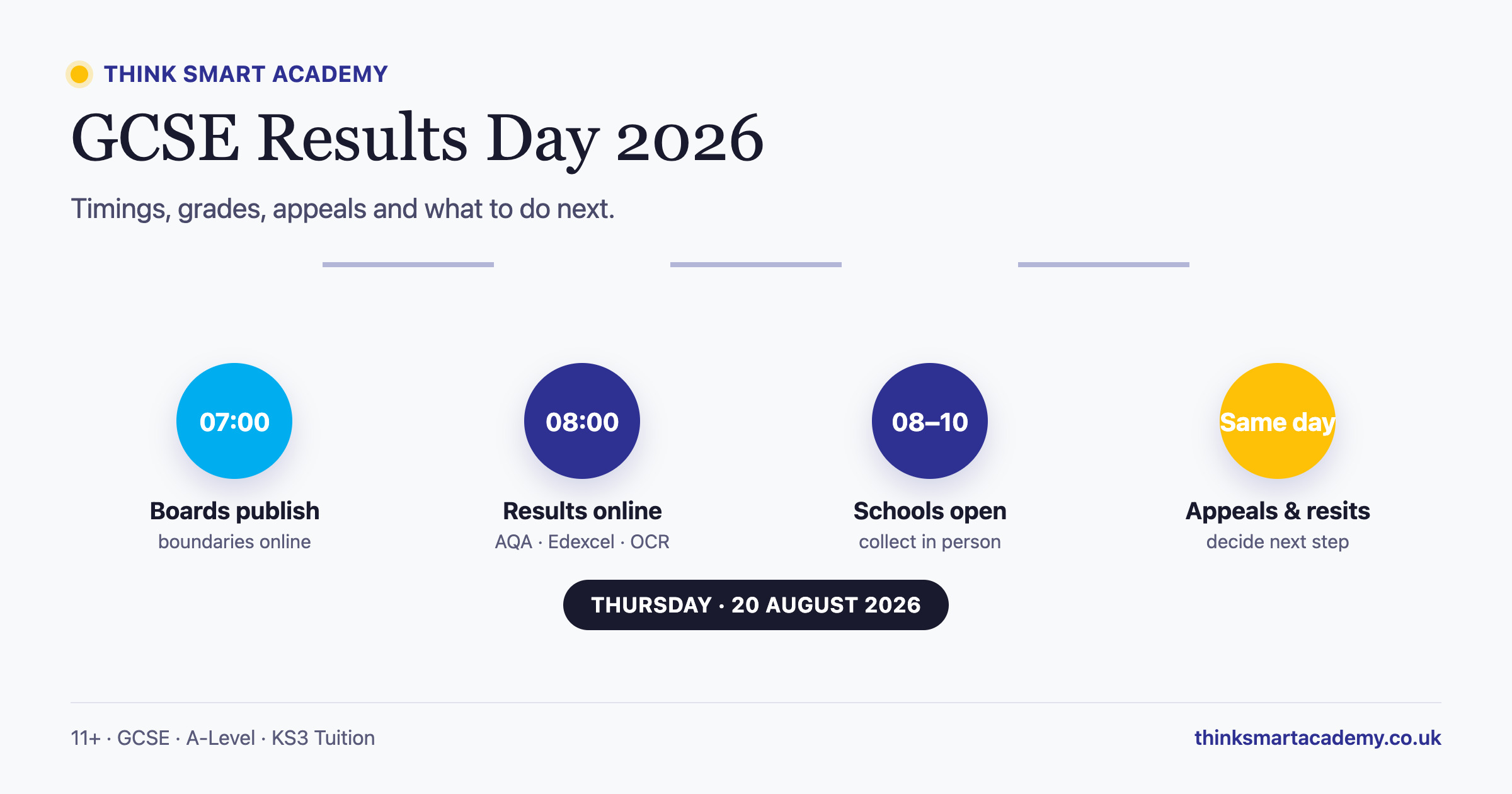
GCSE Results Day 2026 is Thursday 20 August 2026. Schools typically open between 8am and 10am for students to collect their results in person, with most exam boards also releasing results online from 8am. The same date applies to AQA, Edexcel (Pearson), OCR, and WJEC/Eduqas candidates across England, Wales, and Northern Ireland.
If your child’s results are not what you hoped for, there are three real options: request a review of marking, resit in November (GCSE English and Maths only), or rebuild the weak subjects over autumn with structured tuition. You have more time and more choices than most parents realise.
Book a Free Consultation with Think Smart Academy if you want to talk through the options before the 21 September appeals deadline, we have supported families through results day for over ten years.
GCSE Results Day 2026: The Key Facts
| Detail | Information |
|---|---|
| Results day | Thursday 20 August 2026 |
| Earliest collection time | 8am (in person at most schools) |
| Online access | From 8am via school portals; 11am via the Education Record app |
| Exam boards affected | AQA, Edexcel (Pearson), OCR, WJEC/Eduqas, CCEA |
| Schools receive results | Wednesday 19 August 2026 (staff only, embargoed) |
| A-Level Results Day 2026 | Thursday 13 August 2026 |
| November resit registration deadline | Mid-September 2026 (confirm with your school) |
| November resit exam window | Early November 2026 |
| November resit results released | Thursday 14 January 2027 |
The JCQ (Joint Council for Qualifications) confirms that summer 2026 is the seventh full summer series since the 9 to 1 grading reform was completed in 2020. All subjects, new or legacy, use the numbered grading system.
What Time Are GCSE Results Released in 2026?
Most schools open their doors at 8am for in-person collection. A few open slightly later (typically 9am or 10am) to stagger the day. If your child’s school uses an online portal, the results usually appear at the same time as physical envelopes are handed out.
One change worth flagging for 2026: the Education Record app, rolling out nationally across England, will make digital results available at 11am on the day. This is a new government-backed service designed to give students a permanent digital record of their qualifications. It is not a replacement for school collection, but it does mean your child can access a verified copy of their grades on their phone by late morning.
Some parents ask whether they should go with their child. Our honest view after a decade of results days: let them go in with friends if they want to. Younger teenagers often prefer a parent nearby. There is no single right answer, but whatever you decide, agree the plan the night before.
What Each GCSE Grade Actually Means
Grade inflation chatter dominates every August. Here is the framework Ofqual actually uses. A “grade” is a measure of performance against fixed standards, not a percentile in that year’s cohort. According to Ofqual, the 2026 summer series will continue the post-pandemic stability established in 2023.
| Grade | Roughly Equivalent To | What It Signals | Typical University/College Requirement |
|---|---|---|---|
| 9 | High A* | Exceptional performance, top 4% of entries nationally | Top-set sixth form, Oxbridge-competitive cohorts |
| 8 | Low A* / High A | Very strong, secure top set | Russell Group sixth form entry |
| 7 | A | Strong pass, typical A-Level threshold | Most sixth forms require 7+ in the subjects being studied |
| 6 | High B | Solid, capable of A-Level in the right subject | Some A-Level subjects accept a 6 |
| 5 | Low B / High C | Strong pass (the “Gove pass”) | English and Maths 5+ required for many apprenticeships |
| 4 | Low C | Standard pass | Minimum for avoiding compulsory English/Maths resits |
| 3 | D | Below pass | Resit required if English or Maths; BTEC routes possible |
| 2 | E | Limited achievement | Resit required if English or Maths |
| 1 | F/G | Minimal achievement | Resit required if English or Maths |
| U | Unclassified | No grade awarded | Retake required for progression |
The key threshold parents fix on: Grade 4 is a standard pass and Grade 5 is a strong pass. Most sixth forms ask for at least five 4s or 5s including English and Maths before they will enrol a student for A-Levels. Russell Group-aspirant sixth forms often ask for 6s or 7s.
If your child did not get a 4 in GCSE English Language or Maths, they are legally required to continue studying those subjects until age 18. This is the Ofqual “condition of funding” rule, and it is non-negotiable for any college or sixth form receiving public funding.
What to Do if GCSE Results Are Bad
Let us be direct. “Bad” means different things, a missed 4 in Maths is a different problem to a dropped 7 in a subject needed for A-Level. Work through this order:
1. Do not react in the school car park. Give it a day. Results day is emotional for your child and for you. Decisions made on Thursday afternoon rarely survive Saturday morning.
2. Check the mark report against the paper. Most schools can show you the breakdown by paper and by question cluster. If your child was on 74% in mocks and came out with a grade 4 that suggests a mid-40s performance, something went wrong on the day and you should explore a review of marking.
3. Call the sixth form or college. If your child’s offer was conditional on grades they have not hit, most post-16 providers have a Clearing-style flexibility window in the first week. They would rather keep an enrolled student on a different pathway than lose them. Ring first, do not email.
4. Decide between three routes:
- Review of marking, if you think a specific paper was marked too harshly
- November resit, English and Maths only, exam in early November 2026
- Structured autumn tuition, rebuild the weak areas with a view to summer 2027 or a confident sixth-form start
5. Book a consultation with a tutor who knows the exam. A diagnostic conversation, not a sales pitch, will tell you whether the gap is 20 hours of work or 80. We offer this free at both of our centres.
Book a Free Consultation to talk it through with one of our tutors.
GCSE Appeals 2026: Review of Marking Explained
A “review of marking” is a post-results service where a senior examiner checks the original marking of your child’s script to identify clerical errors, adding mistakes, or marking inconsistencies. Reviewers do not re-mark the paper from scratch, they look for errors in the existing marking. According to JCQ guidance, grades can go up, stay the same, or go down after a review, so this is not a risk-free process.
The 2026 Deadlines You Need
| Service | What It Is | Deadline (from results day) |
|---|---|---|
| Priority Review of Marking | For students needing a grade for sixth form or college | Typically within 2 weeks (around 3 September 2026) |
| Standard Review of Marking | All other reviews | Around 21 September 2026 |
| Access to Script (ATS) | See your child’s marked paper before deciding | Usually 25 September 2026 |
| Appeal (after review) | Challenge the review outcome | 30 days from receiving the reviewed grade |
JCQ reports that priority reviews are turned around in about 20 calendar days, and standard reviews can take up to six weeks. Fees vary by board, typically £50 to £80 per script, but are refunded if the grade changes.
One important reality: review of marking only makes sense if there is a specific gap between mock performance and the actual grade. Requesting a review on every paper where your child “felt it went badly” is a poor use of money. According to Ofqual’s 2025 data, fewer than 1% of GCSE grades are changed after review, and the majority of changes are by one grade.
GCSE Resits 2026: Your Options
The UK offers a dedicated November 2026 autumn resit series for GCSE English Language and Maths only. All other GCSE subjects can only be resat in the following summer (May–June 2027).
Here is the resit framework:
| Subject | Autumn 2026 Resit? | Next Opportunity |
|---|---|---|
| GCSE Maths | Yes, November 2026 | Results January 2027 |
| GCSE English Language | Yes, November 2026 | Results January 2027 |
| GCSE English Literature | No | Summer 2027 |
| GCSE Sciences (Combined/Triple) | No | Summer 2027 |
| GCSE History / Geography / Languages | No | Summer 2027 |
| All A-Level subjects | No autumn resit exists | Summer 2027 |
Entry deadlines for the November 2026 series typically fall in mid-September, confirm the exact date with the exam officer at your school or college, because private candidates often face earlier deadlines.
Realistically, ten weeks between results day (20 August) and the November exams is tight. It is enough time to shift a grade 3 to a grade 4 in Maths or English, we have done this with dozens of students, but it requires structured, supervised study, not “do more past papers.” For a detailed revision framework, see our GCSE Revision Timetable 2026 guide.
Why Most Students Underperform, and How to Fix It for 2027
Over ten years of results days at Think Smart Academy, the same pattern repeats. Students who underperform are rarely incapable. They tend to fall into one of four categories:
- Late starters who began revising in March or April and ran out of runway
- Unstructured revisers who re-read notes instead of doing timed past papers
- Topic-avoiders who drilled the topics they enjoyed and skipped the weak ones
- Exam technique gaps, knew the content, lost marks through misreading questions or running out of time
Think Smart Academy’s GCSE programme addresses all four. We run small groups of 6 to 8 students (never large classes), use tracked weekly assessments to catch gaps early, and teach the specific technique each board rewards. Our 93% GCSE improvement rate is built on that method, not on cramming.
If the 2026 results have not landed where you wanted, the autumn term is the right time to rebuild. Book a Free Consultation and we will tell you honestly what a realistic target is, whether that is a November resit or summer 2027.
Local Results Day Support, Slough and High Wycombe
Our two centres will be open on Results Day 2026 for walk-in advice. Parents frequently ring us on the afternoon of results day with specific, urgent questions. We keep the phones staffed.
- Slough centre, 01753 531 818
- High Wycombe centre, 01494 506 281
- Online tuition, available nationally, same small-group model
If you are already thinking about A-Level choices, GCSE resit strategy, or sixth-form transfer routes, we can run a diagnostic assessment within 48 hours. Our GCSE tuition programme runs across all major subjects and exam boards, with free past papers available to current students.
Frequently Asked Questions
When is GCSE Results Day 2026?
GCSE Results Day 2026 is Thursday 20 August 2026. Students can typically collect results from school from 8am onwards. Schools receive the marks the day before (Wednesday 19 August) under embargo, so staff can prepare, but students cannot access them until Thursday morning.
What time can I get my GCSE results online?
Most exam boards and schools release results online from 8am on 20 August 2026, at the same time as in-person collection. From 2026, the new Education Record app will also make verified digital results available from 11am nationwide across England, giving students a permanent record they can share with employers and universities.
What happens if my child fails GCSE English or Maths?
If your child does not achieve a grade 4 in GCSE English Language or Maths, they are required to continue studying those subjects until age 18 as a condition of post-16 funding. They can resit in the November 2026 autumn series. Most colleges build the resit into the timetable automatically.
How much does a GCSE review of marking cost?
GCSE review of marking fees vary by exam board but typically range from £50 to £80 per script for a standard review, with priority reviews costing slightly more. According to JCQ guidance, the fee is refunded in full if the review results in a grade change. Access to Script (seeing the marked paper first) costs less, usually around £15 to £25.
Can I appeal a GCSE grade in 2026?
Yes. The first step is a review of marking (deadline around 21 September 2026 for standard reviews). If you are unhappy with the review outcome, you have 30 days to submit a formal appeal to the awarding body. Appeals are reviewed by an independent panel and can only succeed if there is evidence of a procedural error or an unreasonable marking decision.
How long do I have to apply for a November GCSE resit?
The entry deadline for the November 2026 GCSE resit series is typically mid-September 2026, but exact dates vary by exam board and centre. If your child is enrolled at a sixth form or college, the exam officer will handle registration. Private candidates should contact their exam centre directly. The November resit results are released on Thursday 14 January 2027.
Results day matters, but it is not the final word. Whether this August is a celebration or a reset, the autumn term is where the next twelve months are built. Book a Free Consultation with Think Smart Academy and we will map out the right plan for your child.
Dates and fees reflect JCQ, Ofqual, and exam board guidance as of April 2026. Confirm specific deadlines with your school or college’s exam officer.