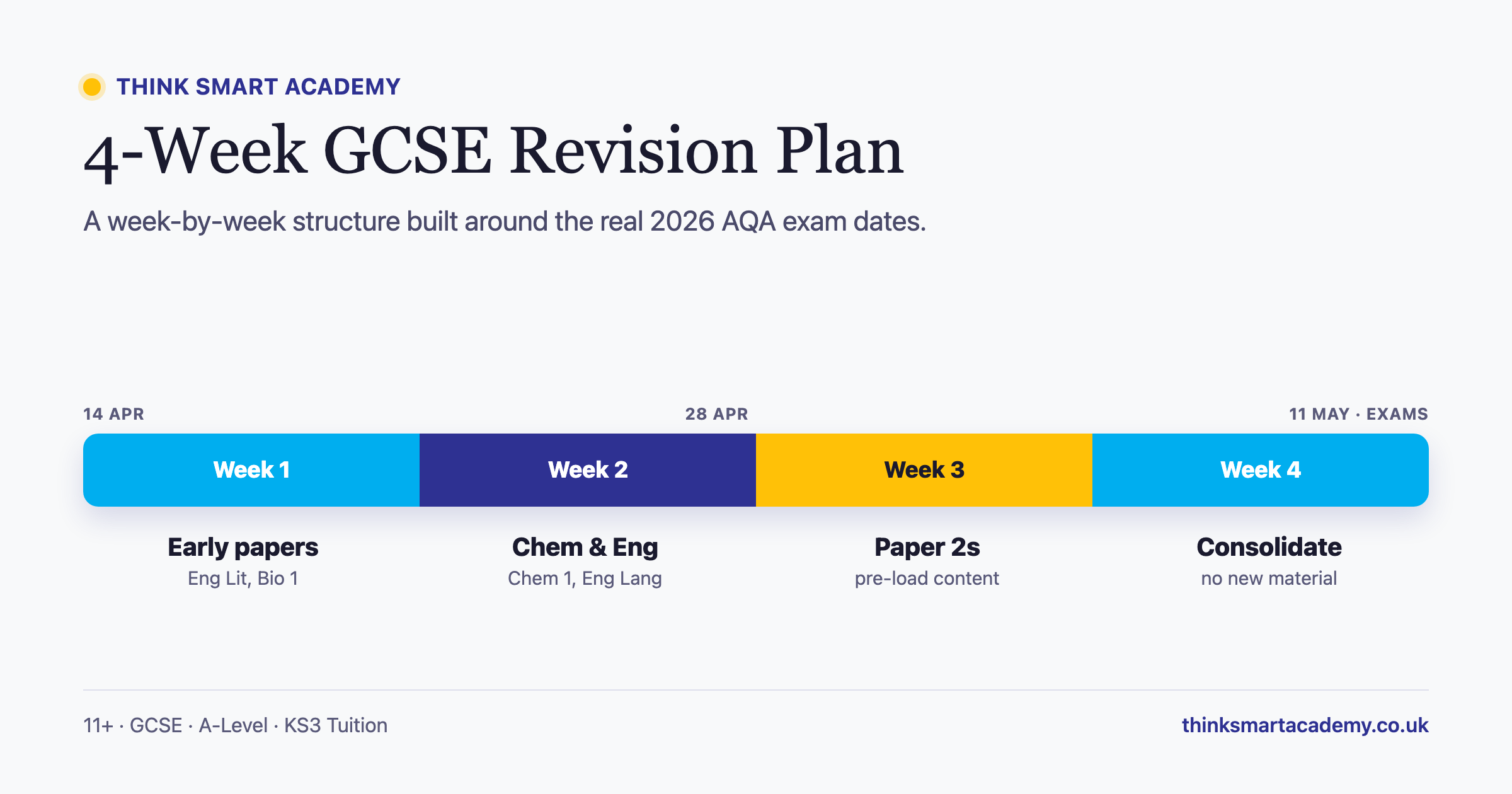
Your first GCSE paper is on Monday 11 May 2026, English Literature Paper 1. Your Maths Paper 1 (Non-Calculator) is on Wednesday 14 May. That means you have roughly four weeks from today to build a revision plan that actually works.
This post gives you a printable GCSE revision timetable template, a week-by-week plan built around the real 2026 AQA exam dates, and subject-specific tips for Maths, English, and Science. No generic advice, just a plan tied to your actual papers.
Free Printable GCSE Revision Timetable Template
Download the GCSE Revision Timetable 2026 template (PDF)
The template is a blank weekly grid you can print and fill in. It has space for:
- Six study sessions per day (morning, afternoon, evening)
- A column for each day of the week
- A notes section for tracking topics completed
- Tick boxes for past papers attempted
How to use it: Print four copies, one for each week leading up to your first exams. Fill in the subjects based on the plan below, then tick off each session as you complete it. The physical act of ticking a box keeps you accountable.
If you prefer a digital version, duplicate the layout in Google Sheets or Notion. The important thing is that you have it written down, not just in your head.
Week-by-Week Revision Plan (2026 Exam Dates)
This plan is built around the AQA exam timetable. If your school uses Edexcel or OCR, the subjects will differ but the structure works the same way, just swap in your actual exam dates from the full GCSE exam timetable 2026.
Week 1: 14–18 April (Four Weeks Before Exams)
Focus: English Literature and Biology Paper 1
This week is about getting your two earliest exams into strong shape before you move on.
| Day | Morning (90 mins) | Afternoon (90 mins) | Evening (60 mins) |
|---|---|---|---|
| Monday | English Lit, Shakespeare quotes & themes | Biology Paper 1, Cell biology | Past paper: English Lit |
| Tuesday | English Lit, 19th century novel revision | Biology Paper 1, Organisation | Maths non-calc practice |
| Wednesday | English Lit, essay technique | Biology Paper 1, Infection & response | Light review |
| Thursday | Maths Paper 1, Number & Algebra | Biology Paper 1, Bioenergetics | Past paper: Biology |
| Friday | Maths Paper 1, Ratio, Proportion & Statistics | English Lit, timed essay | Free evening |
| Saturday | Full Biology Paper 1 past paper (timed) | Mark & review gaps | Rest |
Key target: By the end of this week, you should be able to write a timed English Literature essay and complete a Biology Paper 1 past paper with confidence.
Week 2: 21–25 April (Three Weeks Before Exams)
Focus: Chemistry Paper 1, English Language, and Maths
| Day | Morning (90 mins) | Afternoon (90 mins) | Evening (60 mins) |
|---|---|---|---|
| Monday | Chemistry Paper 1, Atomic structure & bonding | English Language, Paper 1 Question 1–3 | Maths: fractions, decimals, percentages |
| Tuesday | Chemistry Paper 1, Quantitative chemistry | English Language, Paper 1 Question 4 | Light review |
| Wednesday | Chemistry Paper 1, Chemical changes | English Language, Paper 2 practice | Past paper: Chemistry |
| Thursday | Maths Paper 1, Geometry & Measures | English Language, Paper 2 viewpoints | Free evening |
| Friday | Chemistry, full past paper (timed) | Mark & review gaps | Rest |
| Saturday | English Language, full Paper 1 (timed) | Mark & review | Maths practice |
Key target: Complete a full Chemistry Paper 1 and English Language Paper 1 under timed conditions by Saturday.
Week 3: 28 April – 2 May (Two Weeks Before Exams)
Focus: Consolidation and Paper 2 topics
Start introducing Paper 2 content for Science and Maths. Do not wait until after Paper 1 to begin.
| Day | Morning (90 mins) | Afternoon (90 mins) | Evening (60 mins) |
|---|---|---|---|
| Monday | Physics Paper 1, Energy | Maths Paper 2, Algebra & Graphs | English Lit revision |
| Tuesday | Physics Paper 1, Electricity | Maths Paper 2, Statistics | Biology Paper 2 preview |
| Wednesday | Physics Paper 1, Particle model | Chemistry Paper 2 preview | Light review |
| Thursday | Physics, full past paper (timed) | Mark & review | Free evening |
| Friday | Maths, Paper 2 past paper (timed) | Review weakest topics | Rest |
| Saturday | Mixed review, pick your weakest subject | Timed practice on weak topics | Plan next week |
Key target: Have Paper 1 knowledge solid, and Paper 2 topics at least introduced for every subject.
Week 4: 5–10 May (Exam Week Begins)
Focus: Final review, not new content
This is the week exams begin. Do not try to learn new material. Focus on confidence and consolidation.
| Day | Morning (60 mins) | Afternoon (60 mins) | Evening |
|---|---|---|---|
| Monday | English Lit, final quote review | Biology, Paper 1 quick review | Early night |
| Tuesday | Biology Paper 1 (PM exam), light morning review only | Rest after exam | Relax |
| Wednesday | Maths Paper 1 (AM exam), no cramming | Rest after exam | Light Science review |
| Thursday | Chemistry Paper 1, final review | English Language, quick practice | Early night |
| Friday | English Lit Paper 2 prep if applicable | Rest | Relax before the weekend |
Rule for exam week: If your exam is in the morning, do a 30-minute light review at breakfast, then stop. If it is in the afternoon, study in the morning but finish by 11am. Cramming in the final hour before an exam makes performance worse, not better.
Subject-by-Subject Revision Tips
GCSE Maths (AQA 8300)
Your Maths Paper 1 is a non-calculator paper on 14 May 2026. This catches students out every year.
What to revise for Paper 1 (Non-Calculator):
- Written methods for multiplication, division, addition, subtraction
- Fractions, decimals, and percentages without a calculator
- Estimation and rounding
- Solving equations by hand
- Ratio and proportion problems
What to revise for Papers 2 and 3 (Calculator):
- Trigonometry and Pythagoras
- Circle theorems
- Compound interest and growth/decay
- Histograms and cumulative frequency
- Algebraic manipulation with complex expressions
Top tip: Practise with past papers for GCSE Maths under timed conditions. The biggest grade loss in Maths comes from running out of time, not from not knowing the content.
Top tip for aiming at Grade 9: Master the multi-step problems in the last third of the Higher paper. These are where 4- and 5-mark questions live, and they separate Grade 7 students from Grade 9 students.
GCSE English Language (AQA 8700)
Paper 1 is on 21 May and Paper 2 is on 5 June 2026. The 15-day gap between them is a gift, use it.
Paper 1, Creative Reading & Writing:
- Question 1 (4 marks): Simple retrieval, read carefully
- Question 2 (8 marks): Language analysis, use PEE (Point, Evidence, Explanation)
- Question 3 (8 marks): Structure analysis, how does the writer build tension/interest?
- Question 4 (20 marks): Extended comparison, the big mark question, practise this the most
- Question 5 (40 marks): Descriptive or narrative writing, have two pre-planned settings and two pre-planned story openings ready
Paper 2, Writers’ Viewpoints & Perspectives:
- Question 1 (4 marks): Summary of differences
- Question 2 (8 marks): Language analysis of one text
- Question 3 (8 marks): Structure analysis
- Question 4 (16 marks): Comparison of two writers’ perspectives
- Question 5 (40 marks): Persuasive or argumentative writing, practise writing a balanced argument with a clear position
Top tip: Download past papers for GCSE English and practise timed responses. English Language is a skills exam, not a knowledge exam. The more you practise the question formats, the faster you become.
GCSE Combined Science: Trilogy (AQA 8464)
You sit six papers, two for each science. Paper 1 topics and Paper 2 topics are separate. Do not assume revising for Biology Paper 1 covers you for Biology Paper 2.
Biology Paper 1 (12 May) and Paper 2 (8 June):
- Paper 1: Cell biology, organisation, infection & response, bioenergetics
- Paper 2: Homeostasis, inheritance, ecology, evolution
Chemistry Paper 1 (18 May) and Paper 2 (12 June):
- Paper 1: Atomic structure, bonding, quantitative chemistry, chemical changes, energy changes
- Paper 2: The rate of chemical change, organic chemistry, chemical analysis, chemistry of the atmosphere, using resources
Physics Paper 1 (2 June) and Paper 2 (15 June):
- Paper 1: Energy, electricity, particle model of matter, atomic structure
- Paper 2: Forces, waves, magnetism & electromagnetism
Top tip: Use the past papers for GCSE Combined Science to identify which topics you consistently lose marks on. Science is the subject where targeted revision makes the biggest difference, students who focus on their weakest three topics often improve by a full grade.
Common mistake: Students spend too long on topics they already know. If you can answer every question on cell biology correctly, stop revising cell biology and move to the topic you got 3 out of 10 on.
GCSE English Literature (AQA 8702)
Paper 1 (Shakespeare and 19th century novel) is on 11 May, the very first GCSE paper. Paper 2 (modern texts and poetry) is on 19 May.
For Shakespeare:
- Learn 6–8 key quotations that cover major themes (power, conflict, love, ambition, justice)
- Practise writing a 30-minute essay on character development and theme
- Know the context: Jacobean society, the Globe Theatre, Shakespeare’s language choices
For the 19th century novel:
- Focus on the social and historical context, what was life like when the novel was written?
- Practise analysing how the writer creates sympathy or tension through language
- Prepare two strong paragraphs on your novel’s main themes
For poetry (Paper 2):
- You must know all 15 poems from your cluster
- Focus on comparison: learn which poems pair well for theme, tone, or structure
- Practise writing a comparison essay in 30 minutes
Top tip: The mark scheme rewards specific references. Vague statements like “the writer uses language effectively” score nothing. You need: “Shakespeare uses the metaphor of an ‘unruly garden’ to represent the chaos in Denmark”, specific, quoted, explained.
Building Your Own Timetable: The Principles
If the four-week plan above does not fit your schedule, here are the rules for building your own:
-
Work backwards from your first exam. Your earliest paper dictates when revision must start. For most students in 2026, that is English Literature on 11 May or Biology on 12 May.
-
Count the gaps between papers. The AQA timetable gives you natural revision windows. There is a 20-day gap between Maths Paper 1 and Paper 2, that is your best window for fixing Paper 1 mistakes and preparing for Paper 2.
-
Prioritise by marks, not by preference. If you love English but are failing Chemistry, your timetable should have more Chemistry in it. Revising what you enjoy is not the same as revising what will improve your grades.
-
Schedule rest. You cannot revise for 12 hours a day for four weeks. Plan for 4–6 hours of focused revision on weekdays and 2–3 hours on weekends. Take one full day off per week.
-
Use past papers as diagnostics, not just practice. After each past paper, spend as long reviewing your mistakes as you spent doing the paper. The learning happens in the review, not in the sitting.
What If You Are Revising for Other Subjects?
This plan covers the core subjects. If you are also sitting Geography, History, French, or other GCSEs, you need to factor those in. The same principles apply:
- Find out your exam dates from your school’s exam officer
- Map them onto your timetable
- Allocate revision time proportional to the marks available and your current confidence level
- Use our full past papers library to find practice papers for every subject
Still Need Help?
If you are looking at this plan and feeling overwhelmed, that is normal. A revision timetable only works if you know what to revise and how to revise it effectively. That is where tutoring makes the real difference.
At Think Smart Academy, our GCSE tutors help students at our Slough and High Wycombe centres with:
- Targeted topic revision based on your child’s specific weak areas
- Mark scheme training, knowing what examiners actually look for
- Timed practice under exam conditions
- Confidence building for students who are panicking
93% of our GCSE students improve by at least one grade. Book a free consultation →
Download Your Template
- Free GCSE Revision Timetable 2026 template (PDF)
- Full GCSE Exam Timetable 2026, all AQA and Edexcel dates
- Free GCSE past papers for every core subject
This revision plan is based on the confirmed AQA GCSE summer 2026 timetable. Always check your school’s exam officer for confirmation of your child’s specific papers, tiers, and times. Dates for non-core subjects (Geography, History, Languages, etc.) vary, ask your school for the full personalised timetable.