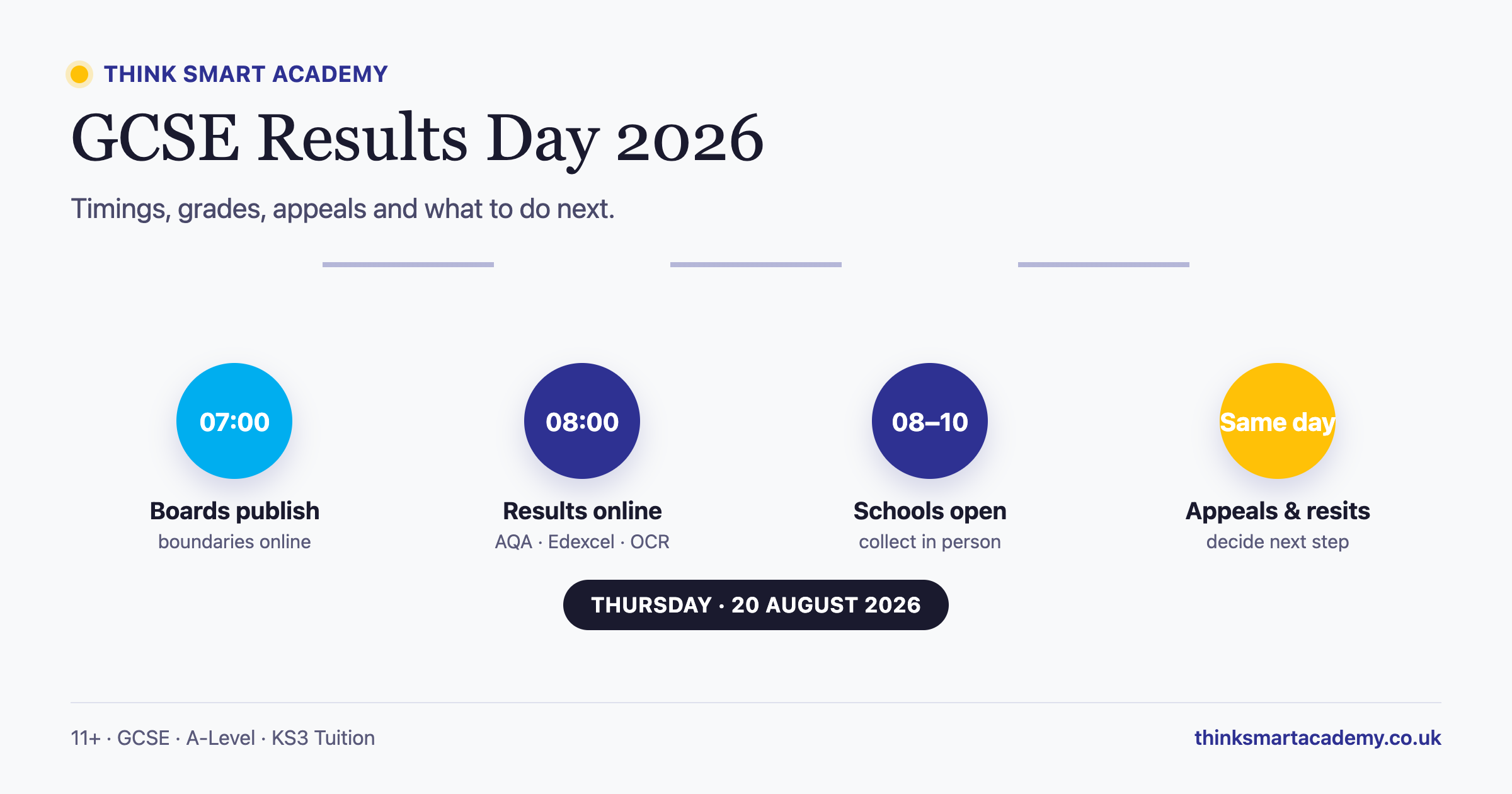
GCSE results day 2027 is Thursday 19 August 2027. That is the date the Joint Council for Qualifications (JCQ) has set for releasing results to students for the June 2027 exams. Schools get the results the day before, on Wednesday 18 August, but only staff can see them. The date is the same for AQA, Edexcel (Pearson), OCR and the other JCQ boards.
Schools set their own collection time, often from 8am, so check with your child’s school. If your child resat English Language or Maths in November 2026, those results come out sooner: on Wednesday 13 January 2027.
This guide covers the key dates, what each grade means, how reviews of marking work, the grade 4 rule for English and Maths, and what to do if results are not what your child hoped for.
GCSE Results Day 2027: The Key Facts
| Detail | Date |
|---|---|
| First exam (GCSE and A-Level) | Monday 10 May 2027 |
| Last GCSE exam | Friday 18 June 2027 |
| Contingency day | Wednesday 23 June 2027 |
| A-Level results day | Thursday 12 August 2027 |
| Schools receive GCSE results (staff only) | Wednesday 18 August 2027 |
| GCSE results day | Thursday 19 August 2027 |
| Collection time | Set by each school, often from 8am |
Source: JCQ key dates for the June 2027 exam series. The contingency day is only used if there is national or significant local disruption to the exams.
November 2026 Resit Results
If your child resat GCSE English Language or Maths in the November 2026 series, results are released to students on Wednesday 13 January 2027. Schools and colleges get them the day before, on Tuesday 12 January. The November exams ran from 2 to 11 November 2026.
If you want a review of marking on a November paper, the school or college must send the request by 18 February 2027, the final date JCQ gives for that series (JCQ key dates, November 2026 series).
What Time Are GCSE Results Released?
There is no single national collection time. Each school decides when students can collect their results and whether they also go out online or by email. Many schools open from about 8am, but some open later to spread the day out. Ask the school office or exams officer before the summer holidays so your child knows the plan.
Grade boundaries come out on the same morning. AQA, for example, says it publishes grade boundaries at 8am on results days (AQA grade boundaries).
What Each GCSE Grade Means
GCSEs in England are graded 9 to 1, with 9 the highest. U means unclassified (no grade).
| Grade | Rough old equivalent | What it means |
|---|---|---|
| 9 | Above A* | The highest grade |
| 8 | A* | Very strong |
| 7 | A | Strong, often asked for in subjects taken at A-Level |
| 6 | High B | Good |
| 5 | Low B / high C | Strong pass |
| 4 | Low C | Standard pass |
| 3 | D / E | Below a standard pass |
| 2 | E / F | Limited achievement |
| 1 | F / G | Lowest grade |
| U | U | Unclassified |
Grade 4 is a standard pass and grade 5 is a strong pass. Sixth forms and colleges set their own entry requirements, so check the exact grades your child’s chosen sixth form asks for. Our GCSE 9 to 1 grades explained guide goes into more detail, and our GCSE grade boundaries 2026 guide shows how many marks each grade needed last summer.
What Happens Without a Grade 4 in English or Maths?
This is the government’s “condition of funding” rule. Students aged 16 to 18 on a 16 to 19 study programme who have not got a grade 4 or above in maths or English must keep studying that subject at their school or college. Students with a grade 3 who are studying full time must work towards the GCSE again. Students with a grade 2 or below can work towards either the GCSE or Functional Skills level 2. A grade 4 in either English Language or English Literature counts for English (gov.uk, maths and English condition of funding).
In practice, your child’s sixth form or college will build the resit into their timetable.
What to Do if GCSE Results Are Disappointing
A missed grade 4 in Maths is a different problem from a 6 where a sixth form wanted a 7. Work through it in this order:
1. Give it a day. Results day is emotional for everyone. Decisions made on Thursday afternoon often look different by Saturday.
2. Compare the result with the mocks. If your child was working well above the grade in mocks and on past papers, talk to the subject teacher about whether a review of marking makes sense.
3. Ring the sixth form or college. If an offer depended on grades your child has not quite reached, call them quickly. Ask whether they can still offer a place, or a different course.
4. Choose a route:
- Review of marking, if there is a real reason to think a paper was marked too harshly
- November resit, for English Language and Maths
- Planned tuition through Year 12, to rebuild the weak areas before a resit
5. Get an honest view. A short conversation with a tutor who knows the exam will tell you how big the gap really is. Book a free 30-minute consultation and we will talk it through.
Reviews of Marking
A review of marking means the exam board checks that the original marking was done correctly. It is not a fresh re-mark. A few points parents often do not know:
- The school makes the request, not you. JCQ says exam boards will only accept review requests from schools and colleges, not from students or parents. Speak to the exams officer.
- Grades can go down as well as up. Your child will be asked to agree to the review before the school sends it, because the grade could fall.
- There are fixed deadlines. JCQ publishes the deadlines for each series in its post-results services guide, and schools pass them on to students. Exam boards charge a fee for each review, so ask the school how this is handled.
A review makes most sense when there is a clear gap between the result and the evidence from mocks and classwork. It is less useful just because a paper “felt bad”.
GCSE Resits: November and Summer
The November series is only for GCSE English Language and Maths. AQA says that only students who will be at least 16 years old on 31 August of that year can be entered for these November exams (AQA entries). Schools and colleges handle the entries, and the deadline comes early in the autumn term, so ask straight after results day.
For students who get their results in August 2027, other GCSE subjects can next be taken in the summer 2028 exams (May to June 2028).
The gap between results day and the November exams is short. It is enough time to move up a grade with steady, focused work, but it needs a plan. Our GCSE revision timetable guide shows how to set one up.
Why Students Underperform, and How to Fix It
Over 10 years of helping families, we see the same patterns again and again. Students who underperform are rarely incapable. Most fall into one of four groups:
- Late starters, who began revising in the spring and ran out of time
- Passive revisers, who re-read notes instead of doing timed past papers
- Topic avoiders, who practised what they enjoyed and skipped the hard topics
- Exam technique gaps, who knew the content but lost marks by misreading questions or running out of time
Our GCSE classes have a maximum of 8 students, with regular progress reports and teaching built around what each exam board rewards. 93% of our GCSE students improve by at least one grade. If mocks are coming up, our guide to mock results and what to do next shows how to use them well, and our free past papers are a good place to start.
Frequently Asked Questions
When is GCSE results day 2027?
GCSE results day 2027 is Thursday 19 August 2027. Schools receive the results the day before, Wednesday 18 August, but students cannot see them until results day. The date comes from the JCQ key dates for the June 2027 exams.
What time are GCSE results released?
There is no single national time. Each school sets its own collection time, often from 8am, and decides whether results also go out online. Check with your child’s school before the summer holidays.
When are the November 2026 GCSE resit results out?
Results for the November 2026 English Language and Maths resits are released to students on Wednesday 13 January 2027. Schools and colleges receive them a day earlier. The final date for review requests for that series is 18 February 2027.
What happens if my child does not get a grade 4 in Maths or English?
If they stay in education on a 16 to 19 study programme, they must keep studying the subject as a condition of funding. Students with a grade 3 who are studying full time work towards the GCSE again. Students with a grade 2 or below can take the GCSE or Functional Skills level 2.
How do I ask for a review of marking?
Speak to your child’s school or college, usually the exams officer. Exam boards only accept requests from schools, not from parents or students. Your child will need to agree to it, because grades can go down as well as up.
When are the 2027 grade boundaries published?
Grade boundaries for the June 2027 GCSE exams are published on results day, Thursday 19 August 2027. Each board posts its own on its website. AQA says it publishes grade boundaries at 8am on results days.
When is A-Level results day 2027?
A-Level results day 2027 is Thursday 12 August 2027, one week before GCSE results day. Schools and colleges receive A-Level results the day before, on Wednesday 11 August.
Support in Slough, High Wycombe and Online
Whether results day is a celebration or a reset, the next few months are where the next step is built. We run GCSE tuition in small groups at our Slough and High Wycombe centres, and online. Book a free 30-minute consultation and we will help you plan the right next step for your child.
Dates checked against JCQ, gov.uk and AQA guidance in November 2026. Confirm deadlines with your child’s school or college exams officer.