The 2027 GCSE exams run from Monday 10 May to Friday 18 June 2027, with a contingency day on Wednesday 23 June in case of national disruption (JCQ key dates). That gives Year 11 a clear finish line to plan towards.
This guide is for Year 11 students and their parents. It covers our free revision timetable tool, a plan that works from whenever you start (from mocks in January through to the exams), subject-by-subject tips for Maths, English and Science with the AQA 2027 paper dates, and the principles for building a timetable of your own.
Free GCSE Revision Timetable Template
The quickest way to get a timetable is our free Revision Timetable Builder. It takes about two minutes:
- Enter your first exam date. For most AQA students in 2027, that is Tuesday 11 May (Biology Paper 1 and Combined Science Biology Paper 1).
- Set your study hours for a typical weekday and a typical weekend day.
- Add your subjects and rate each one Beginner, Intermediate or Confident.
The builder then gives you a week-by-week plan. Weaker subjects get more time, and subjects are rotated across the week rather than studied in long blocks. You can print it or save it as a PDF from your browser’s print option. Nothing is stored on our servers, so keep a copy.
Review the plan every couple of weeks. When a subject moves from Beginner to Confident, update it so the time goes where it is needed.
A Revision Plan From Mocks to May
Most students do not start revising on the same date, so this plan works in phases rather than fixed weeks. Pick up from whichever phase you are in.
Phase 1: After the mocks (January)
Mock results are the best guide you will get to where marks are being lost. Go through each marked paper and sort lost marks into knowledge gaps, exam technique and timing. Then pick two or three priority subjects. Our guide to mock results and what to do next walks through this step by step.
At this stage, short regular sessions alongside schoolwork are enough. Aim to cover one weak topic per subject each week.
Phase 2: February half term
Half term is the first chance for a longer block of revision. Use it to:
- Finish a first pass of the topics flagged in the mocks
- Do one timed past paper in each priority subject
- Make or update flashcards for key facts, formulas and quotations
Leave some days completely free. A rested student revises better after the break.
Phase 3: The Easter holidays
Easter is the biggest revision window before the exams. In 2027, Good Friday is 26 March and Easter Monday is 29 March (gov.uk bank holidays). School Easter holiday dates vary, so check your school’s calendar.
This is the time for full timed past papers, followed by careful marking against the mark scheme. Here is a sample week:
| Day | Morning (90 mins) | Afternoon (90 mins) | Evening (60 mins) |
|---|---|---|---|
| Monday | Maths: timed Paper 1 (non-calculator) | Mark it and fix mistakes | English Literature quotations |
| Tuesday | Biology: weakest Paper 1 topic | English Language: Paper 1 Questions 1 to 3 | Light review |
| Wednesday | Chemistry: weakest Paper 1 topic | English Literature: timed essay | Free evening |
| Thursday | Physics: weakest Paper 1 topic | Maths: weakest topic from the last paper | Flashcards |
| Friday | English Language: timed Paper 2 | Mark it against the mark scheme | Rest |
| Saturday | Full science past paper (timed) | Review gaps | Rest |
| Sunday | Rest day | Rest day | Plan next week |
Phase 4: The final four weeks
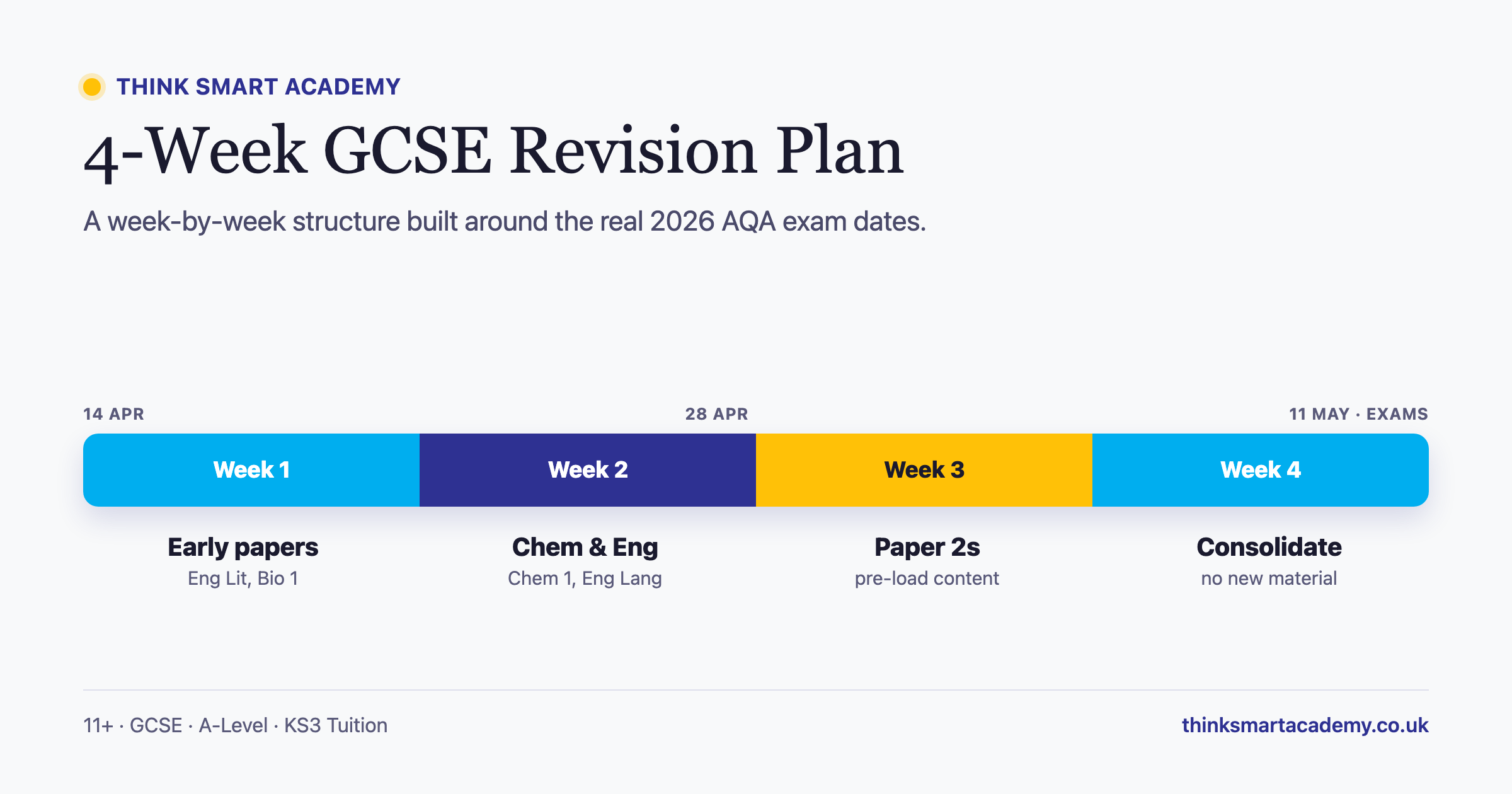
In the four weeks before the first exam, put the papers in the order you sit them. The earliest papers get more time first, but keep every subject ticking over. Start Paper 2 topics in Science and Maths now; do not wait until after Paper 1.
| Day | Morning (90 mins) | Afternoon (90 mins) | Evening (60 mins) |
|---|---|---|---|
| Monday | First exam subject: past paper questions | Maths: mixed practice | Light review |
| Tuesday | Second exam subject: weakest topic | English Language practice | Flashcards |
| Wednesday | Science Paper 2 topics | English Literature: timed essay | Free evening |
| Thursday | Maths: timed past paper | Mark and review | Light review |
| Friday | First exam subject: timed past paper | Mark and review | Rest |
| Saturday | Mixed review of weakest subject | Timed practice on weak topics | Plan next week |
| Sunday | Rest day | Rest day | Rest day |
Phase 5: Exam weeks
Once exams start, do not try to learn lots of new material. Use the gaps between papers to review the next exam’s topics and to do short timed questions. If an exam is in the morning, a short, light review at breakfast is plenty. Get enough sleep, eat properly and keep some time free each day. Our guide to the last week before GCSEs has more tips for the final stretch.
Subject-by-Subject Revision Tips
The dates below are from AQA’s GCSE May/June 2027 timetable, and all are morning exams. If your child sits Edexcel or OCR, ask their school for the right dates.
GCSE Maths (AQA 8300)
AQA Maths has three papers of 1 hour 30 minutes:
- Paper 1 (non-calculator): Friday 14 May 2027
- Paper 2 (calculator): Thursday 27 May 2027
- Paper 3 (calculator): Monday 14 June 2027
For the non-calculator paper: practise written methods, fractions, decimals and percentages without a calculator, estimation and solving equations by hand.
For the calculator papers: make sure your child knows their own calculator well, and practise topics such as trigonometry, Pythagoras, compound interest and graphs.
Top tip: do GCSE Maths past papers under timed conditions. Running out of time is a common way to lose marks, and timed practice is the fix.
GCSE English Language (AQA 8700)
- Paper 1 (Explorations in creative reading and writing): Monday 24 May 2027
- Paper 2 (Writers’ viewpoints and perspectives): Tuesday 8 June 2027
AQA updated some questions from summer 2026, and 2027 uses the same format. Our guide to the AQA English Language changes explains each one.
Paper 1:
- Question 1 (4 marks): now multiple choice. Read the named lines carefully and shade one answer for each part.
- Question 2 (8 marks): how the writer uses language.
- Question 3 (8 marks): how the writer uses structure to create a single named effect, such as tension.
- Question 4 (20 marks): evaluation. Students say how far they agree and/or disagree with a statement about part of the extract.
- Question 5 (40 marks): descriptive or narrative writing. The narrative option can ask for an opening rather than a whole story.
Paper 2:
- Question 1 (4 marks): choose four true statements about part of Source A.
- Question 2 (8 marks): a summary that uses details from both sources.
- Question 3 (12 marks): how the writer uses language in one source.
- Question 4 (16 marks): compare how the two writers convey their views or feelings, including their methods.
- Question 5 (40 marks): writing to present a viewpoint on a statement.
Top tip: use GCSE English Language past papers for timed practice. English Language is a skills exam, so practising the question types is what makes students faster and more confident.
GCSE Combined Science: Trilogy (AQA 8464)
Combined Science has six papers of 1 hour 15 minutes, two each for Biology, Chemistry and Physics:
- Biology: Paper 1 Tuesday 11 May, Paper 2 Thursday 10 June 2027
- Chemistry: Paper 1 Monday 17 May, Paper 2 Tuesday 15 June 2027
- Physics: Paper 1 Tuesday 25 May, Paper 2 Friday 18 June 2027
Paper 1 and Paper 2 cover different topics, so revising for Biology Paper 1 does not cover Biology Paper 2.
- Biology Paper 1: cell biology, organisation, infection and response, bioenergetics. Paper 2: homeostasis and response, inheritance, variation and evolution, ecology.
- Chemistry Paper 1: atomic structure and the periodic table, bonding, quantitative chemistry, chemical changes, energy changes. Paper 2: rates of reaction, organic chemistry, chemical analysis, the atmosphere, using resources.
- Physics Paper 1: energy, electricity, particle model of matter, atomic structure. Paper 2: forces, waves, magnetism and electromagnetism.
Top tip: use GCSE Combined Science past papers to find the topics where marks are lost most often, then put those topics into the timetable first. If your child already scores well on a topic, move on to a weaker one.
GCSE English Literature (AQA 8702)
- Paper 1 (Shakespeare and the 19th-century novel): Wednesday 12 May 2027, 1 hour 45 minutes
- Paper 2 (Modern texts and poetry): Wednesday 19 May 2027, 2 hours 15 minutes
Literature comes early in the exam season, so start it early in the timetable.
For Shakespeare and the 19th-century novel: learn a small set of short quotations for each main character and theme, and practise timed essays that start from the extract and then move to the whole text.
For poetry: know all 15 poems in your child’s anthology cluster, and practise comparing pairs of poems. Unseen poetry is also on Paper 2, so reading and discussing poems your child has not seen before is useful practice.
Top tip: examiners reward specific, well-explained references to the text. Short quotations that your child can explain in detail are worth more than long ones they cannot.
Building Your Own Timetable: The Principles
If you would rather build a timetable by hand, these rules matter most:
- Work backwards from the first exam. Your child’s earliest paper sets when the final phase must start.
- Count the gaps between papers. Look at the timetable for longer gaps between papers in the same subject. Those gaps are good windows to fix mistakes from the first paper and prepare for the next one.
- Prioritise by need, not by preference. If your child loves English but is struggling in Chemistry, the timetable should have more Chemistry in it.
- Schedule rest. Build in at least one day off each week and some free evenings. A timetable that cannot be kept is no use.
- Use past papers as diagnostics. After each paper, spend real time on the mistakes. The learning happens in the review, not just in the sitting.
For other subjects, the same principles apply. Get the dates from your child’s school, add them to the timetable, and use our past papers library to find practice papers. Our GCSE grade calculators help turn practice scores into a grade.
Frequently Asked Questions
When should Year 11 start revising for GCSEs?
Our advice is to start a regular weekly routine straight after mock results come back, then use February half term and the Easter holidays for longer blocks. That leaves the final four weeks for past papers rather than learning topics for the first time.
How many hours a day should my child revise?
This is our tutors’ guidance rather than a fixed rule: around 2 to 3 hours on a weekday and 3 to 5 hours on a weekend day is sustainable for most GCSE students in the final months, with one rest day a week. Earlier in the year, less is fine. Focused, regular sessions matter more than very long days.
When do GCSE exams start in 2027?
The 2027 GCSE exams start on Monday 10 May 2027 and the last scheduled exam is on Friday 18 June 2027, according to JCQ. Wednesday 23 June 2027 is a contingency day, so students should stay available until then.
How do I make a GCSE revision timetable?
Start with the date of the first exam and work backwards. List every subject, rate how confident your child is in each, and give weaker subjects more time. Rotate subjects across the week, include past papers, and build in rest days. Our free Revision Timetable Builder does this for you.
Is there a free GCSE revision timetable template?
Yes. Our free Revision Timetable Builder creates a personalised week-by-week plan from your exam date, study hours and subjects. You can print it or save it as a PDF, and you do not need to sign up.
Need Help With Revision?
A revision timetable works best when your child knows what to revise and how. At Think Smart Academy, our GCSE tutors at our Slough and High Wycombe centres help with targeted topic revision, mark scheme training and timed practice under exam conditions.
93% of our GCSE students improve by at least one grade. Book a free 30-minute consultation to talk through your child’s plan.
Sources: JCQ key dates for the June 2027 exam series, AQA GCSE May/June 2027 exam timetable and gov.uk bank holidays. Checked on 20 November 2026. Always check your child’s personal timetable with their school.