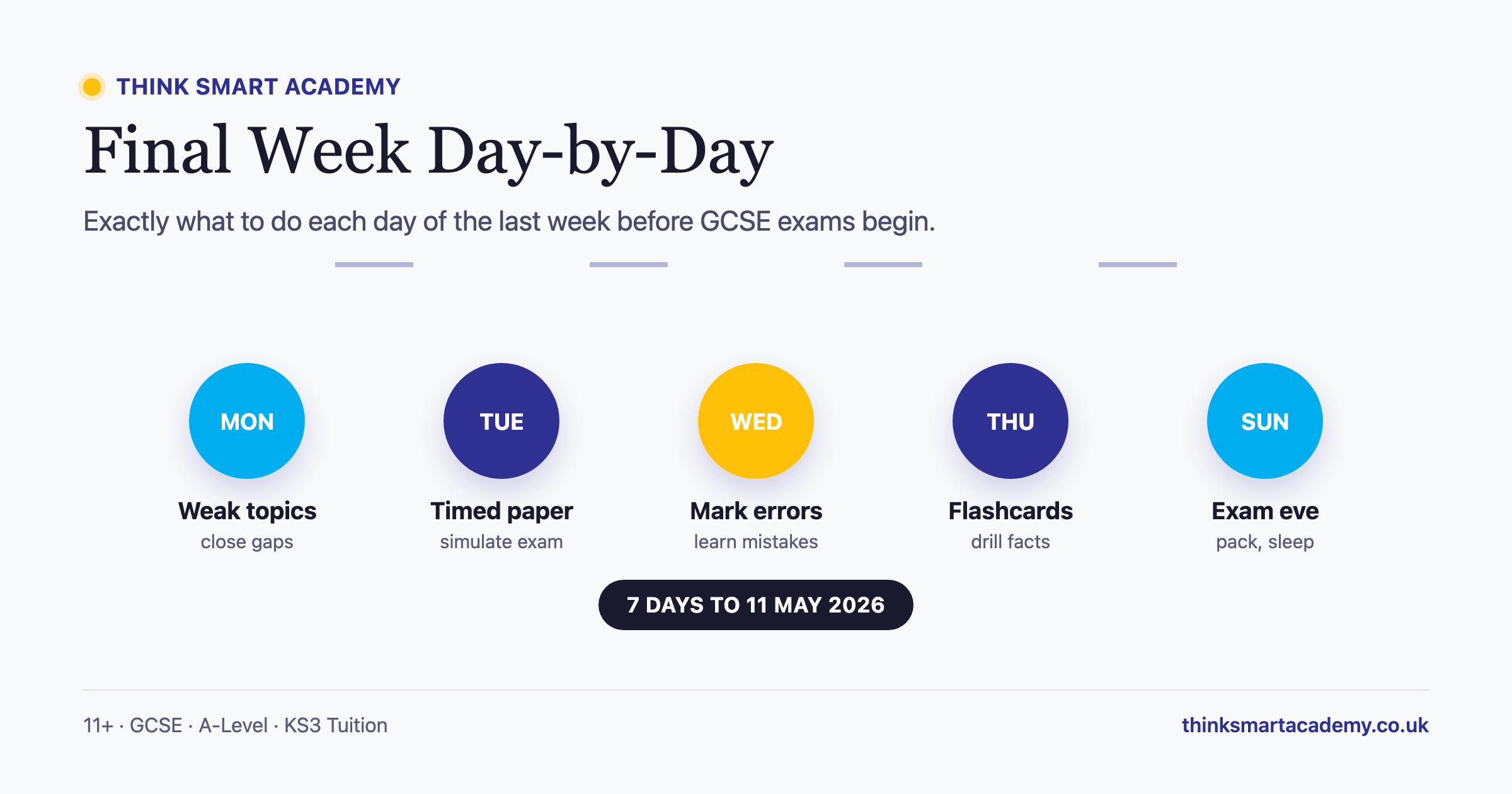
The last week before GCSEs starts is not the time to learn new content. It is the time to consolidate, practise under pressure, and build confidence. This day-by-day plan tells you exactly what to do each day, so you walk into your first exam feeling prepared, not panicked.
GCSE exams for summer 2026 begin on Monday 11 May with English Literature Paper 1. If you are reading this in late April or early May, you are right on schedule.
The 7-Day Last-Minute Revision Plan
This plan assumes your exams start on Monday 11 May 2026. Adjust the days if your first paper falls on a different date, check our GCSE exam timetable 2026 for exact dates.
| Day | Focus | Time Needed |
|---|---|---|
| Monday | Review weakest topics | 3–4 hours |
| Tuesday | Timed past paper | 2–3 hours |
| Wednesday | Mark and correct errors | 2 hours |
| Thursday | Flashcard sprint | 2–3 hours |
| Friday | Light review only | 1–2 hours |
| Saturday | Full rest day | None |
| Sunday | Exam-eve preparation | 30 minutes |
Monday: Review Your Weakest Topics
Goal: Identify and close the biggest gaps in your knowledge.
Start by listing the three topics you are most worried about across all subjects. These are the topics where you consistently lose marks in practice papers or feel unsure when revising.
Spend 3–4 hours working through these topics using your notes, textbook, or subject guides. Do not try to cover everything, focus only on the topics that will cost you the most marks.
Resources:
- GCSE Maths past papers, practise the topics you find hardest
- GCSE English past papers, focus on question types you struggle with
- GCSE Combined Science past papers, target the topics with the lowest scores
Tip: If you do not know your weak topics, do a quick diagnostic: spend 15 minutes on each subject writing down everything you can remember. The gaps will become obvious.
Tuesday: Do a Timed Past Paper
Goal: Simulate exam conditions and test your recall under pressure.
Choose one past paper for your first exam subject. Set a timer. Work through the entire paper without notes, without stopping, and without checking your phone.
This is not about getting a perfect score. It is about practising the skill of recalling information under time pressure, which is exactly what you will do on exam day.
Resources:
- All GCSE past papers, download papers for any subject
- Use the official time allocation for your exam board (AQA, Edexcel, or OCR)
Tip: Sit at a desk, not your bed. Use a pen, not a pencil. Treat it like the real thing.
Wednesday: Mark and Correct Your Paper
Goal: Turn mistakes into learning opportunities.
Take the paper you completed yesterday. Mark it using the official mark scheme (included with every past paper on our site). Be honest, do not give yourself marks for answers that are close but not quite right.
For every question you got wrong or partially wrong:
- Read the mark scheme answer
- Write out the correct answer in full
- Note which topic the question was testing
- Add that topic to your flashcard pile for Thursday
Resources:
- GCSE Maths mark schemes, every paper includes the mark scheme
- GCSE English mark schemes, check model answers against yours
- GCSE Combined Science mark schemes, compare your explanations to the expected responses
Tip: If you scored below 50%, do not panic. You have identified exactly what you need to fix before exam day.
Need help turning weak topics into strong ones? Our GCSE tutors in Slough and High Wycombe can work through past papers with you and explain the mark scheme in plain English. Book a free trial session →
Thursday: Flashcard Sprint
Goal: Drill key facts, definitions, and formulas into your memory.
Take the topics you identified on Monday and Wednesday. Create flashcards, physical cards or an app like Anki or Quizlet, covering:
- Maths: Key formulas, common calculation methods, algebraic rules
- English: Quotation banks for your set texts, key terminology (e.g., metaphor, alliteration, inference)
- Science: Definitions, equations, practical method descriptions, key diagrams
Work through the flashcards in focused 25-minute blocks with 5-minute breaks (the Pomodoro technique). Aim for 3–4 blocks across the day.
Resources:
- GCSE Maths topic guides, includes formula sheets and worked examples
- GCSE English revision guides, quotation banks and essay frameworks
- GCSE Combined Science revision guides, key equations and practical summaries
Tip: Focus on the flashcards you get wrong. Skip the ones you know. The goal is to spend your time on gaps, not to feel good about what you already know.
Friday: Light Review Only
Goal: Consolidate without exhausting yourself.
Reduce your revision to 1–2 hours maximum. Spend this time:
- Reading through your flashcard pile one final time
- Glancing at your corrected past paper from Wednesday
- Reviewing any summary sheets or mind maps you have made earlier in the year
Do not attempt new past papers. Do not try to learn new content. Do not revise late into the evening.
Tip: If you feel like you should be doing more, you are probably ready. Trust the preparation you have done over the past months.
Saturday: Full Rest Day
Goal: Give your brain a break before exam week.
This is the most important day in the plan. Your brain consolidates memories during rest, cramming on Saturday will actually make you perform worse on Monday.
Do something you enjoy. Go outside. See friends. Watch a film. Sleep in.
The only revision-related task allowed: check your exam timetable one more time so you know exactly when and where your first paper is. See our GCSE exam timetable 2026 for dates and times.
Tip: If you feel guilty about not revising, remember that rest is part of the strategy, not a break from it.
Sunday: Exam-Eve Preparation
Goal: Remove stress by getting organised.
Spend 30 minutes on the following:
- Pack your bag: Calculator (with fresh batteries), black pens (at least two), pencils, ruler, rubber, sharpener, protractor, compass, clear pencil case, water bottle, and your exam timetable
- Set your alarm: Give yourself plenty of time in the morning, rushing adds stress
- Lay out your clothes: One less decision to make tomorrow
- Go to bed early: Aim for 8–9 hours of sleep. Your brain performs best when rested
Do not revise on Sunday evening. If you feel tempted, put your notes in another room.
Tip: If you feel nervous, that is normal. Nervous energy means you care, and it sharpens your focus when the exam starts.
What If I Have Less Than a Week?
If you are reading this with fewer than seven days before your first exam, prioritise in this order:
- Do one timed past paper (Tuesday’s plan)
- Mark it and correct errors (Wednesday’s plan)
- Flashcard the weak topics (Thursday’s plan)
- Rest the day before (Saturday’s plan)
Even two days of focused revision is better than a week of unfocused panic.
Frequently Asked Questions
How many hours should I revise in the last week before GCSEs?
Aim for 2–4 hours per day from Monday to Thursday, then reduce to 1–2 hours on Friday. Take Saturday completely off. Quality matters more than quantity, focused revision on weak topics is more effective than eight hours of passive reading.
Should I revise the night before my GCSE exam?
No. The night before your exam should be for rest and preparation, not revision. Pack your bag, check your timetable, and go to bed early. Your brain will perform better with sleep than with an extra hour of cramming.
What if I have not revised enough before the last week?
Focus on high-impact revision: do one past paper under timed conditions, mark it honestly, and revise only the topics where you lost marks. This targeted approach is more effective than trying to cover the entire syllabus in a few days. Consider booking a focused tuition session to quickly address your weakest areas.
What should I do between GCSE exams?
Use the gaps between papers to revise for your next exam, but do not overdo it. One focused revision session (2–3 hours) per gap day is sufficient. Check the GCSE exam timetable to plan your revision around paper dates.
Need Support in the Final Stretch?
If your child is struggling with last-minute revision, our GCSE tutors can help. We offer:
- Focused sessions on weak topics, no time wasted on what your child already knows
- Past paper walkthroughs with mark scheme explanations
- Exam technique coaching for Maths, English, and Science
- Sessions at our Slough and High Wycombe centres, or online
93% of our GCSE students improve by at least one grade. The first step is a free consultation to identify where your child needs the most help.
Book a free GCSE consultation →
This revision plan is designed for students whose exams begin on 11 May 2026. Adjust the days if your exam board or school follows a different schedule. Always check your school’s exam officer for confirmation of your specific papers and times.