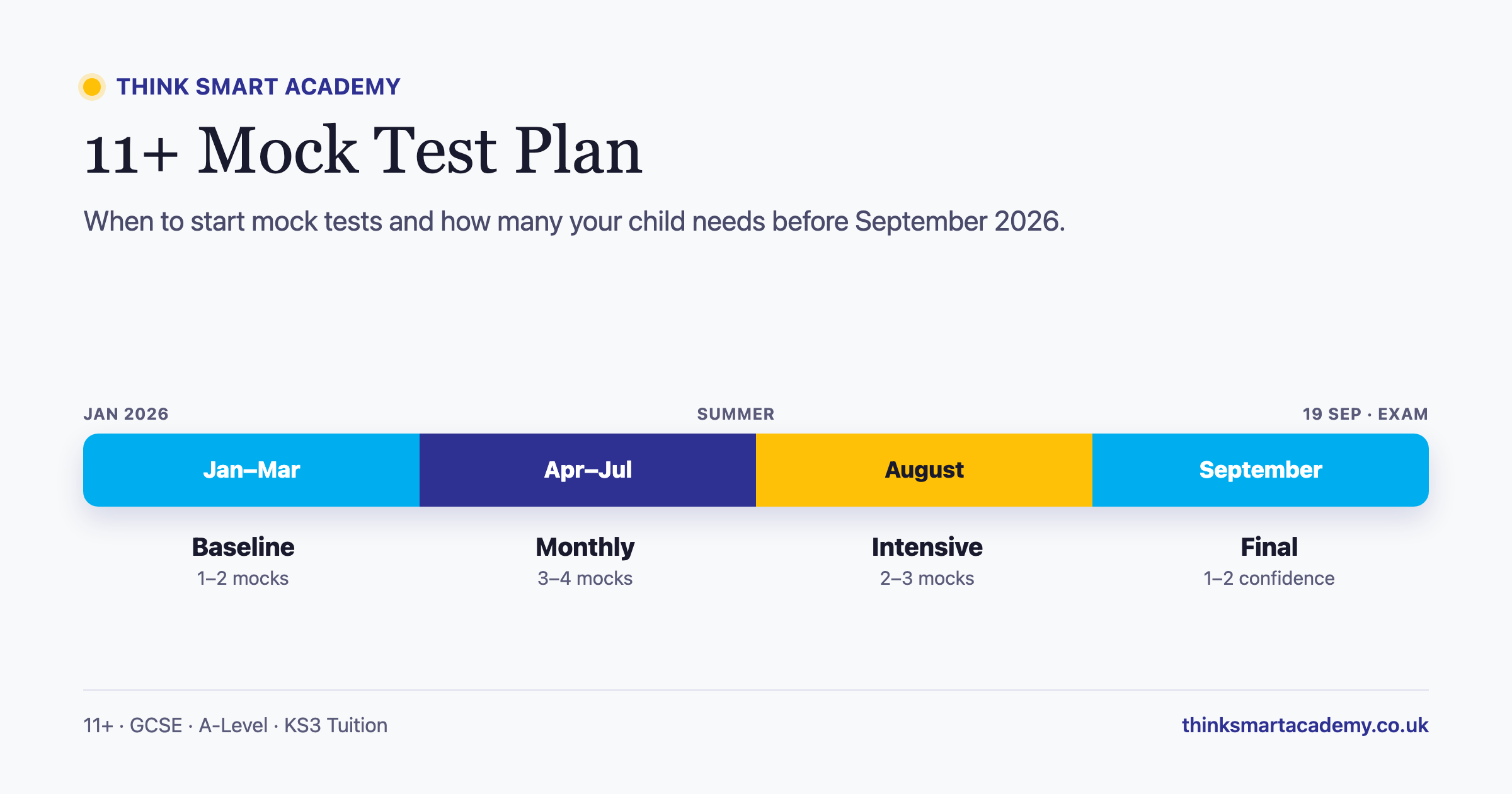
The Slough Consortium 11+ exam is on Saturday 19 September 2026. If your child is preparing for grammar school entry in September 2027, mock tests are the single most effective preparation tool available, but only if they are used correctly.
This guide covers what a good mock test looks like, when to start, how many your child needs, and the common mistakes that waste preparation time.
What the Slough Consortium 11+ Exam Looks Like
Before discussing mock tests, you need to understand exactly what your child will face on exam day. The Slough Consortium uses GL Assessment papers. Your child sits two papers on the same day with a short break in between.
| Paper | Content | Duration | Format |
|---|---|---|---|
| Paper 1, Verbal Skills | Reading comprehension, grammar, punctuation, spelling, verbal reasoning | ~60 minutes | Multiple choice |
| Paper 2, Non-Verbal Skills | Non-verbal reasoning, spatial reasoning, mathematics (KS2 curriculum) | ~60 minutes | Multiple choice |
All answers are marked on a separate answer sheet using Optical Mark Recognition (OMR). Raw scores are converted to age-standardised scores, a score of 111 or above makes your child eligible for grammar school consideration.
The four consortium schools, Herschel Grammar, Langley Grammar, St Bernard’s Catholic Grammar, and Upton Court Grammar, all use this same score. One exam covers all four schools.
What a Good Mock Test Should Replicate
Not all mock tests are equal. A useful mock test must replicate the real exam as closely as possible:
Format
- GL Assessment style, not CEM, not Bond, not generic reasoning papers. The Slough Consortium switched to GL Assessment from September 2023. Any mock using CEM-style questions is preparing your child for the wrong exam.
- Two papers with a short break, mirroring the real exam structure.
- Multiple-choice answer sheets, your child needs to practise filling in separate answer grids accurately and quickly. Many students lose marks not because they don’t know the answer, but because they fill in the wrong bubble or skip a line.
Conditions
- Strict timing, no extra minutes, no pausing. The real exam does not allow extensions.
- Unfamiliar environment, sitting at a desk at home is not the same as sitting in a school hall with 200 other children. Mock tests in an exam-like setting build familiarity with the pressure.
- No parental help, during a mock, your child should receive no prompts, encouragement, or guidance. The real exam has an invigilator, not a parent.
Scoring
- Age-standardised scoring, so you can see where your child sits relative to the 111 qualifying threshold, not just a raw percentage.
- Detailed breakdown by subject area, verbal, non-verbal, maths, comprehension, so you can identify which areas need the most work.
Mock Tests vs Practice Papers: What’s the Difference?
Parents often conflate these. They are different tools with different purposes.
| Mock Test | Practice Paper | |
|---|---|---|
| Environment | Exam hall, timed, invigilated | Kitchen table, flexible timing |
| Purpose | Simulate the real experience | Build knowledge and technique |
| Scoring | Age-standardised, benchmarked | Self-marked or parent-marked |
| Stress level | Moderate (deliberately) | Low |
| Frequency | Monthly or termly | Weekly |
| Best for | Building exam stamina and confidence | Identifying and filling knowledge gaps |
Both are essential. Practice papers build skills. Mock tests prove those skills work under pressure.
The mistake most parents make: doing dozens of practice papers at home but never sitting a real mock test. Their child knows the content but panics on exam day because they have never experienced the time pressure, the unfamiliar room, or the anxiety of sitting next to 200 other children.
When to Start Mock Tests
Year 4 (12–18 months before the exam)
- No formal mocks yet. Focus on building core skills, reading, arithmetic, reasoning puzzles.
- Introduce GL Assessment question types informally so your child recognises the format.
Year 5, Autumn Term (September–December 2025)
- Begin untimed practice papers to learn question types and techniques.
- Aim for one practice paper per week covering each subject area.
Year 5, Spring Term (January–April 2026)
- Introduce timed practice papers at home, strict timing, no help.
- Sit your first formal mock test under exam conditions. This baseline result tells you exactly where your child stands and which areas need the most work.
- At Think Smart Academy, our termly mock exams run under real exam conditions with age-standardised scoring.
Year 5, Summer Term (May–July 2026)
- Increase to one formal mock test per month alongside weekly practice papers.
- Use mock results to redirect preparation, if comprehension scores are strong but maths is lagging, shift the balance of weekly sessions.
- Summer holiday intensive: this is when most students make their biggest gains. Consider an intensive summer course with built-in mock tests.
Year 6, September 2026 (Final Weeks)
- Complete 2–3 final mock tests under strict conditions in the first two weeks of September.
- Do not sit a mock test in the final 3–4 days before the exam. At this point, your child should be resting and building confidence, not cramming.
- Exam day: Saturday 19 September 2026.
How Many Mock Tests Does Your Child Need?
There is no magic number, but as a benchmark:
| Stage | Mock Tests | Practice Papers |
|---|---|---|
| January–March 2026 | 1–2 (baseline + follow-up) | 8–12 |
| April–July 2026 | 3–4 (monthly) | 16–20 |
| August 2026 | 2–3 (intensive phase) | 8–10 |
| September 2026 | 1–2 (final confidence check) | 4–6 |
| Total | 7–11 formal mocks | 36–48 practice papers |
The key is not volume, it’s what you do with the results. A child who sits 5 mock tests and thoroughly reviews every error will outperform a child who sits 20 mock tests and never looks at the results.
How to Use Mock Test Results
After every mock test, follow this process:
Step 1: Review the Score in Context
Look at the age-standardised score, not just the raw marks. A raw score of 85% might be above or below 111 depending on the difficulty of that particular paper. The standardised score tells you whether your child is on track.
Step 2: Identify the Weakest Areas
Break the results down by subject:
- Verbal reasoning, logic, word patterns, analogies
- Reading comprehension, inference, vocabulary in context
- Mathematics, number, measurement, geometry, data handling
- Non-verbal reasoning, shapes, patterns, sequences, spatial awareness
If your child consistently loses marks in one area across multiple mocks, that area needs targeted intervention, not more practice papers in areas they already score well in.
Step 3: Analyse the Errors
Not all wrong answers are the same:
- Didn’t know the method → needs teaching
- Made a careless mistake → needs slower, more careful reading
- Ran out of time → needs speed practice on that section
- Misread the question → needs exam technique coaching
Step 4: Adjust the Preparation Plan
Use mock results to shift the balance of weekly preparation. If maths is consistently strong but verbal reasoning is weak, reduce maths practice time and increase verbal reasoning. Revisit the balance after the next mock.
11+ Mock Test Providers in Slough: Price Comparison
There are several options for mock tests in the Slough area, ranging from free official materials to full exam-hall experiences. Here is a comparison of the main providers for the 2026 season:
| Provider | Type | Price per Mock | What’s Included |
|---|---|---|---|
| GL Assessment (official) | Free PDF download | Free | Familiarisation materials, essential starting point |
| Prep4All | Online, on-demand | £10 | Instant marking, percentile ranking |
| 11++ Tuition (Langley) | In-person | £25–40 | Audio instructions, performance report |
| Atom Learning | Online (unlimited) | £70/month | Unlimited mocks + full learning platform |
| KSOL | Online (6 windows) | £70 | Exam report, 2-hour video review |
| Think Smart Academy | In-person (Slough) | From £15/h | Integrated with tuition, termly mocks included |
| Marie Redmond (Langley Academy) | In-person exam hall | £55–80 | 5 Slough papers, volume discounts, DBS-checked invigilators |
| Teachitright (Slough) | In-person exam hall | £80 | Review videos, personal report within 3 days |
| Susan Daughtrey Education (Langley) | In-person exam hall | £65–85 | 7 paper sets, video tuition access, score comparisons |
Start with the free GL Assessment materials at gl-assessment.co.uk, every parent should use these before paying for any mock. They include 10 hours of familiarisation content across all tested subjects.
For exam-hall experience, the providers running at Langley Academy and other local venues (Marie Redmond, SDE, Teachitright) offer the closest simulation of real exam conditions, unfamiliar venue, invigilators, other students, strict timing.
Common Mistakes Parents Make with Mock Tests
1. Using CEM Materials for a GL Assessment Exam
The Slough Consortium switched to GL Assessment in 2023. CEM papers test different skills in different ways. If your child’s mock tests use CEM-style questions, the results will not accurately predict their performance on the real GL Assessment paper. Check the provider and the paper format before booking.
2. Doing Too Many Mocks Without Reviewing
Sitting mock test after mock test without analysing the results is like running laps without checking your time. The value of a mock is in the debrief, not the test itself. Every mock should generate a clear list of 3–5 specific topics to work on before the next mock.
3. Creating Anxiety Instead of Confidence
Mock tests should build familiarity with the exam, not create dread. If your child is visibly distressed before every mock, you are doing too many or putting too much pressure on the score. Scale back the frequency and focus on framing mocks as practice, not judgement.
4. Only Practising at Home
Home practice is essential for building knowledge, but it does not replicate exam conditions. Your child needs at least some mock tests in an unfamiliar environment with other students, a strict time limit, and no parental presence.
5. Starting Too Late
Families who begin mock tests in August 2026 (one month before the exam) miss the opportunity to use results to guide preparation. The first mock should happen no later than spring 2026, giving 5–6 months to address the weaknesses it reveals.
6. Ignoring the Answer Sheet
GL Assessment uses a separate OMR answer sheet. Students who have never practised filling in a multiple-choice grid under timed conditions often make transfer errors, selecting the right answer but marking the wrong bubble. Practise with answer sheets from the first mock onwards.
What to Expect on Exam Day
The Slough Consortium 11+ exam takes place on a Saturday in September at one of the consortium school venues. Here is what your child can expect:
- Arrive early, registration opens approximately 30 minutes before the exam starts
- Bring a pencil (HB), eraser, and water bottle. No calculators, no phones, no smartwatches
- Two papers with a short break in between
- Approximately 2.5 hours from arrival to finish (including registration and break)
- Results released in mid-October via the consortium portal, log in with the credentials you created during registration
Children who have sat multiple mock tests under similar conditions will find exam day familiar rather than frightening. That familiarity is worth more than any last-minute revision.
Think Smart Academy Mock Exams
At Think Smart Academy, our 11+ programme includes termly mock exams under real exam conditions:
- GL Assessment format, two papers, strict timing, separate answer sheets
- Sat in our centre with other students (not at home)
- Age-standardised scoring with detailed breakdown by subject area
- Individual feedback: which topics to focus on before the next mock
- Results compared against previous mocks to track progress over time
Our regular 11+ tuition sessions also incorporate timed practice papers weekly, so students build both knowledge and exam stamina throughout the programme.
We run sessions at our Slough and High Wycombe centres, with small groups (maximum 8 students) from £15 per hour.
Start with a free diagnostic assessment. We test your child across all four 11+ subjects, provide an age-standardised baseline score, and recommend a preparation plan tailored to their strengths and weaknesses.
The Slough Consortium 11+ exam for September 2027 entry is expected on Saturday 19 September 2026. Registration opens 1 May 2026 and closes 5 June 2026. An online information evening with headteachers from all four grammar schools is scheduled for 28 April 2026. For full registration details, read our 11+ Registration 2027 guide.