Summer 2026 is the critical window for children sitting the 11+ exam in September. If your child is in Year 5 and aiming for a grammar school place in Slough or High Wycombe, an 11+ summer course can seem like the obvious next step. But with providers ranging from national online platforms to local intensive workshops, choosing the right option is not straightforward.
This guide compares the main 11+ summer course providers serving the Slough and High Wycombe areas, explains what a good summer programme should cover, and sets out a week-by-week plan you can follow at home or alongside tuition. We also explain why, for many families, structured ongoing tuition delivers better results than a short summer crash course.
Why Summer Matters for 11+ Preparation
The Slough Consortium 11+ exam takes place in mid-September. The Buckinghamshire 11+ (for High Wycombe schools) is around the same time. That gives your child roughly 10 to 12 weeks of summer holiday between the end of Year 5 and exam day.
For children who have been preparing since Year 4 or earlier, summer is about sharpening technique, building speed, and closing remaining gaps. For those starting later, and when to start 11+ preparation is a common question, summer may be the first period of focused study.
Either way, the summer break is unstructured. Without school routines, children can lose weeks to distraction. A structured programme, whether a formal course, ongoing tuition, or a disciplined home plan, keeps momentum going right up to exam day.
11+ Summer Course Providers in Slough & High Wycombe
Several providers offer summer courses aimed at children preparing for grammar school entrance in the local area. Below is a comparison of the main options.
Provider Comparison Table
| Provider | Format | Duration | Typical Cost | Subjects Covered | Location |
|---|---|---|---|---|---|
| Adnan Khan Tutoring | Online + in-centre | Ongoing (summer intensives available) | From £120/month | English, Maths, VR, NVR | Online / Slough centre |
| Marie Redmond Tuition | In-centre group classes | 2–4 week blocks | £200–£400+ per block | English, Maths, VR, NVR | Beaconsfield / local venues |
| SDE (Slough Distance Education) | In-centre | 1–4 week courses | £150–£350+ per course | English, Maths, VR | Slough |
| Examberry | In-centre group courses | 1–2 week intensives | £250–£500+ per course | English, Maths, VR, NVR | Windsor / Maidenhead area |
| Think Smart Academy | In-centre + online, ongoing tuition | Year-round (summer is part of ongoing programme) | 11+ from £150/month, group from £15/hr, 1-to-1 from £30/hr | English, Maths, VR, NVR, exam technique | Slough / High Wycombe |
Adnan Khan Tutoring
Adnan Khan Tutoring is one of the best-known names in the Slough area. They offer online resources alongside in-centre sessions and run additional classes over the summer. Their online platform provides practice questions children can work through independently, which can be useful for supplementing other preparation.
The strength of Adnan Khan is accessibility and volume of practice material. However, classes can be large, and the online component requires a self-motivated child to benefit fully. Parents looking for highly personalised attention may find the group format limiting.
Marie Redmond Tuition
Marie Redmond is a well-established provider based in the Beaconsfield area, popular with families in South Bucks and parts of High Wycombe. Their summer courses typically run in 2- to 4-week blocks with a structured curriculum covering all four 11+ subjects.
Marie Redmond courses are well-regarded for their structured approach and experienced tutors. The limitation is geography, centres are primarily in Beaconsfield, which may not be convenient for families in Slough or central High Wycombe. Pricing is at the higher end for group courses.
SDE (Slough Distance Education)
SDE operates locally in Slough and offers summer intensive courses specifically targeting the Slough Consortium exam. Their courses tend to focus on English and Maths with some verbal reasoning coverage.
SDE’s local focus means they understand the Slough Consortium format well. However, course availability can be limited and places fill up quickly. Some parents report that the teaching approach is fairly traditional and may not suit every learning style.
Examberry
Examberry runs intensive summer courses in the Windsor and Maidenhead area. They are known for rigorous academic content and well-structured course materials. Their courses typically involve several hours of daily study over one- or two-week blocks.
Examberry’s intensity suits children who are already at a strong level and need to refine exam technique. For children who still have significant gaps in core knowledge, the pace may be too fast. The Windsor location also adds travel time for families based in Slough or High Wycombe.
Think Smart Academy
At Think Smart Academy, we take a different approach. Rather than running a standalone summer course, our 11+ tuition is a year-round programme, and summer is simply the most intensive phase.
Our 11+ tuition in Slough and High Wycombe runs throughout the year, so by summer your child is already working at the right level with a tutor who knows their strengths and weaknesses. There is no “ramp-up” period wasted on assessment or getting to know the child.
Our pricing:
- 11+ ongoing tuition from £150/month
- Small group sessions from £15/hour
- 1-to-1 sessions from £30/hour
During summer, we increase session frequency, add timed practice papers, and focus specifically on exam technique, time management, and the areas where each child needs the most improvement. This tailored approach consistently outperforms generic intensive courses where every child follows the same plan regardless of their starting point.
What a Good 11+ Summer Course Should Cover
Whether you choose a formal course, ongoing tuition, or a structured home plan, any effective summer programme for the 11+ should cover the following:
1. All Four Subjects
The Slough Consortium exam tests English, Maths, Verbal Reasoning, and Non-Verbal Reasoning. Some providers focus heavily on English and Maths while neglecting reasoning. This is a mistake, reasoning skills are unfamiliar to most children and need dedicated practice.
2. Timed Practice Papers
Doing practice questions is not the same as doing practice papers under timed conditions. Your child needs to experience the pressure of completing a full paper within the time limit. This builds stamina, reveals time management issues, and reduces anxiety on the day.
Aim for at least two full timed papers per week during the summer, ideally one English and one Maths/Reasoning.
3. Exam Technique
Many children lose marks not because they lack knowledge but because they do not understand what the question is asking. Training in how to read questions carefully, eliminate wrong answers, and manage time across a paper is essential.
4. Personalised Gap Analysis
A one-size-fits-all approach wastes time. If your child is strong in Maths but struggles with reading comprehension, the summer programme should reflect that. Look for providers who assess your child’s level and adjust the programme accordingly.
5. Confidence Building
The 11+ is stressful. A good programme should build your child’s confidence through progressive challenge, not destroy it with work that is too difficult or volumes of homework that cause burnout.
Red Flags to Watch For
Not all summer courses deliver on their promises. Watch out for these warning signs:
Guaranteed pass claims. No provider can guarantee a grammar school place. The exam is competitive and outcomes depend on many factors. Providers who promise results are being dishonest.
No assessment before enrolment. If a provider puts your child into a course without assessing their current level, the content may be too easy or too hard. Either wastes valuable summer time.
Excessive class sizes. In a group of 20 or more children, individual attention is minimal. For an exam as competitive as the 11+, your child needs targeted feedback, not generic instruction.
Homework without feedback. Setting practice papers is only useful if someone marks them and explains the mistakes. Courses that pile on homework without review are not adding value.
No track record or results data. Ask for evidence of past results. Reputable providers will be able to share outcomes (while respecting privacy) and connect you with parent references.
Courses that end before the exam. A two-week course in July that finishes six weeks before the September exam leaves a long gap where skills can deteriorate. Look for programmes that continue right up to exam day.
Week-by-Week Summer 11+ Preparation Plan
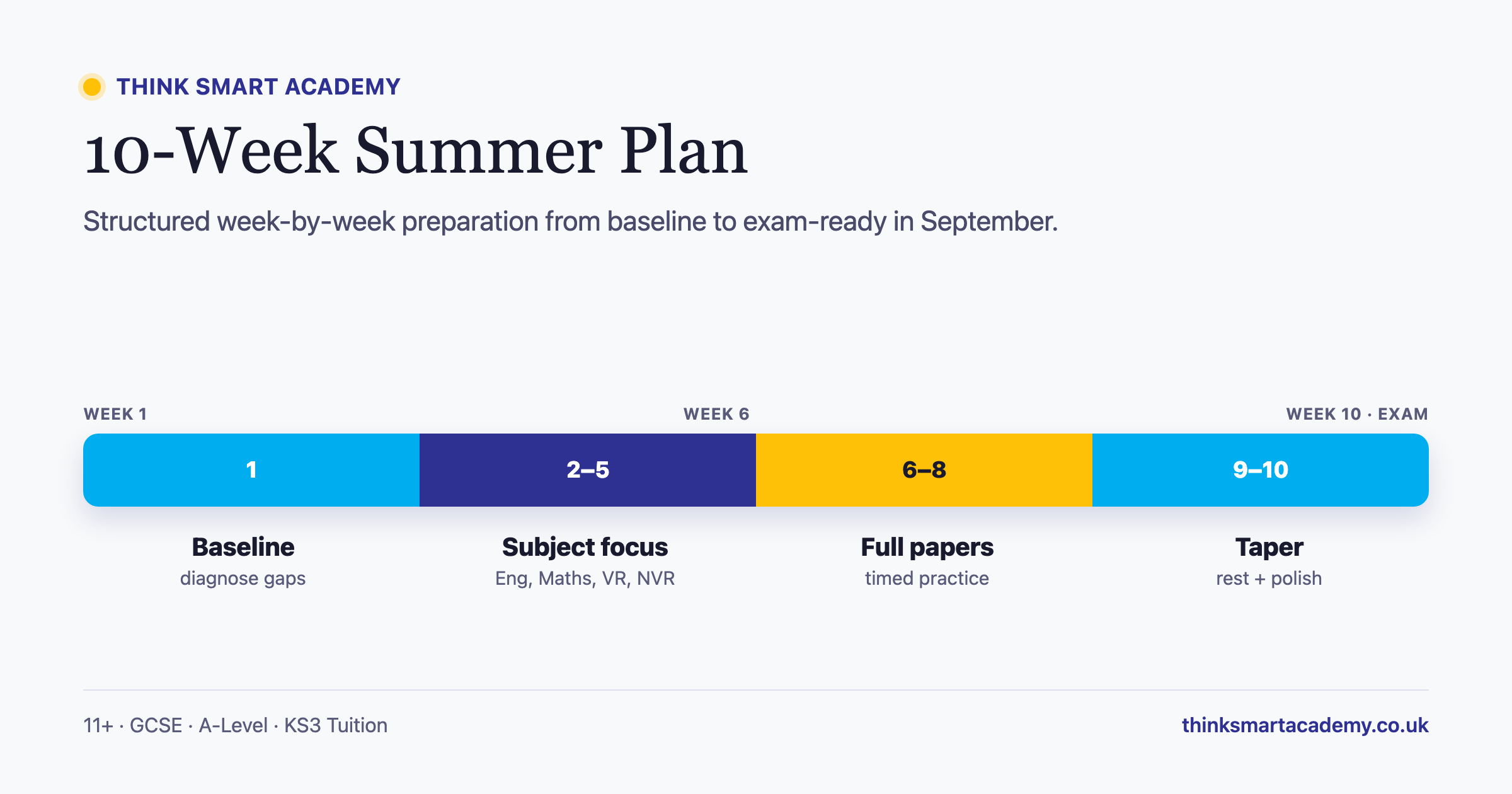
Whether you are supplementing a formal course, working with a tutor, or preparing at home, this 10-week plan provides structure for the summer holiday leading up to a mid-September exam.
Week 1: Baseline Assessment
- Complete one full English paper and one full Maths/Reasoning paper under timed conditions.
- Mark both papers and identify weak areas by topic.
- Create a list of the 10–15 topics that need the most work.
- Set a realistic schedule: aim for 1.5 to 2 hours of focused study per day.
Week 2: English Focus
- Work through reading comprehension strategies, inference, prediction, vocabulary in context.
- Practice 2–3 comprehension passages with written answers.
- Revise grammar rules: punctuation, sentence types, paragraphing.
- Complete one timed English paper at the end of the week.
Week 3: Maths Focus
- Target weak topics identified in Week 1 (fractions, percentages, ratio, geometry, word problems).
- Do 20–30 practice questions per day on focus topics.
- Complete one timed Maths paper at the end of the week.
Week 4: Verbal Reasoning
- Learn and practise the main VR question types: codes, analogies, cloze passages, odd one out, shuffled sentences.
- Do 30–40 VR questions per day, covering a mix of question types.
- Complete one timed VR section at the end of the week.
Week 5: Non-Verbal Reasoning
- Work through NVR patterns: rotation, reflection, shape sequences, grid completion.
- Use online NVR resources for additional practice.
- Complete one timed NVR section at the end of the week.
Week 6: Full Paper Practice
- Complete two full timed papers (one English, one reasoning/maths).
- Review all errors and update the topic gap list.
- Revisit any topics where marks were still being lost.
Week 7: Speed and Accuracy
- Focus on increasing speed without losing accuracy.
- Practise completing papers in 90% of the allocated time.
- Work on exam technique: reading questions twice, eliminating wrong answers, not leaving blanks.
Week 8: Mixed Practice and Confidence
- Alternate between subjects daily.
- Complete two more full timed papers.
- Celebrate progress, acknowledge improvements since Week 1.
Week 9: Final Papers
- Complete two to three full timed papers under exam-like conditions (quiet room, no interruptions, strict timing).
- Review results and focus revision on any remaining weak areas.
- Reduce study intensity slightly to avoid burnout.
Week 10: Light Revision and Rest
- Do light revision only, short sessions focusing on key formulas, vocabulary, and question strategies.
- No new material. Focus on consolidating what is already known.
- Ensure good sleep, nutrition, and exercise.
- The day before the exam: no study. Rest, relax, and build confidence.
Why Ongoing Tuition Beats a Standalone Summer Course
Summer courses have a fundamental limitation: they are a snapshot. A child joins, works intensively for a few weeks, and then the support stops. If the course finishes in July and the exam is in September, there is a gap, and during that gap, momentum is lost.
Ongoing tuition solves this problem. At Think Smart Academy, children in our 11+ programme work with the same tutor throughout the year. By summer, the tutor already knows exactly where the child is strong and where they need help. There is no wasted time on assessment or settling in, summer sessions are immediately productive.
Our approach also means the summer does not exist in isolation. It is part of a continuous arc of preparation that began months earlier and continues right up to exam day. This produces more consistent progress and less stress for both children and parents.
Think Smart Academy pricing for 11+ tuition:
| Option | Price |
|---|---|
| Ongoing 11+ tuition | From £150/month |
| Small group sessions | From £15/hour |
| 1-to-1 sessions | From £30/hour |
All of our 11+ tuition covers English, Maths, Verbal Reasoning, and Non-Verbal Reasoning, with regular timed practice papers and personalised feedback.
If you are considering a summer course but want the continuity and personalisation that produces the best results, we recommend booking a free consultation to discuss your child’s needs.
Frequently Asked Questions
When should my child start preparing for the 11+?
Most families begin structured preparation in Year 4 or early Year 5. Starting in Year 4 allows a gentle build-up of skills without pressure. Starting later is possible but requires more intensive work. For a detailed timeline, see our guide on when to start 11+ preparation.
Is a summer course enough to pass the 11+?
For children who have already been preparing and are close to the required level, a well-run summer course can provide useful final polishing. For children starting from a weaker position, a summer course alone is rarely sufficient. They need the longer runway that ongoing tuition provides, which is why our year-round programme includes intensive summer sessions as standard.
How many hours per day should my child study over summer?
For most children, 1.5 to 2 hours of focused study per day is the right balance. More than this risks burnout, particularly as the exam approaches. Quality matters more than quantity, one hour of concentrated work with proper feedback is worth more than three hours of unfocused worksheet completion.
Should I choose a group course or 1-to-1 tuition?
Group courses suit children who are already performing well and benefit from a structured class environment. They are also more affordable. However, if your child has specific weaknesses or is easily distracted in group settings, 1-to-1 tuition delivers faster results. At Think Smart Academy, we offer both, small group sessions from £15/hour and 1-to-1 from £30/hour, and can advise on the best fit during a free consultation.
Next Steps
If your child is sitting the 11+ in September 2026, now is the time to plan your summer preparation. Whether you choose a formal summer course, home study, or ongoing tuition, the key is structure, consistency, and starting early enough to make real progress.
To discuss how Think Smart Academy can support your child’s 11+ preparation, over summer and throughout the year, book a free consultation with one of our experienced tutors. We work with families across Slough and High Wycombe and can tailor a programme to your child’s specific needs.
For more information about grammar school entry, read our guides to 11+ registration for 2027, 11+ tuition in Slough, and 11+ tuition in High Wycombe.