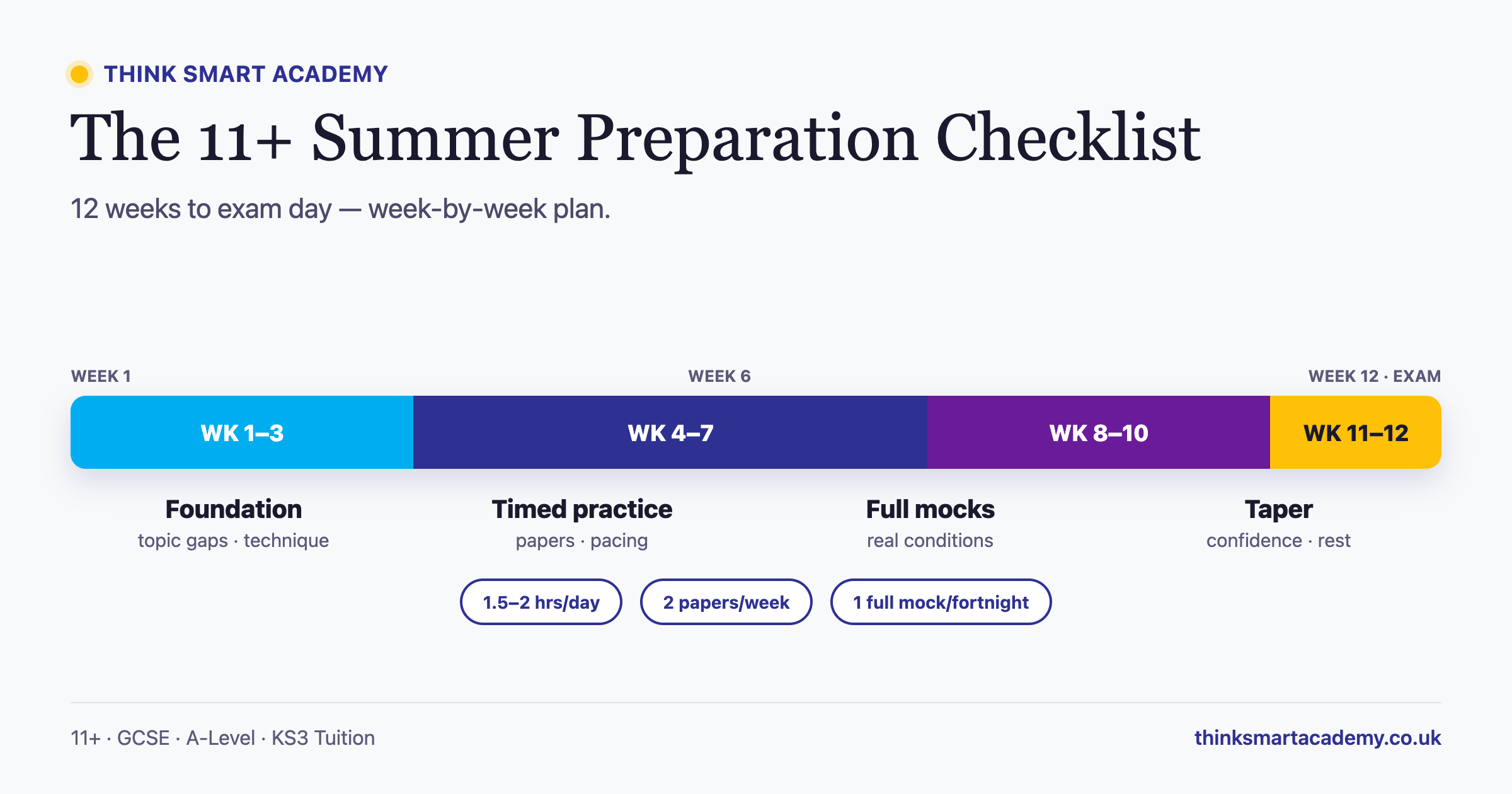
Your child’s 11+ exam is roughly 12 weeks away. To prepare effectively over summer, your child needs around 1.5 to 2 hours of focused study per day, at least two timed practice papers per week, and a plan that moves from foundation work to full mocks to light tapering. This post gives you the exact 12-week checklist, organised week by week.
Quick Overview: 12 Weeks at a Glance
The 2026 exam dates are fixed. The Buckinghamshire 11+ Secondary Transfer Test falls on Thursday 10 September 2026. The Slough Consortium 11+ follows on Saturday 19 September 2026. That means summer preparation starts in earnest in mid-June and runs for around 12 weeks.
| Phase | Weeks | Focus | Weekly Hours |
|---|---|---|---|
| Foundation | Weeks 12–9 | Diagnostics, gap-filling, core technique | 8–10 |
| Practice | Weeks 8–5 | Subject rotation, timed sections | 10–12 |
| Mocks | Weeks 4–2 | Full timed papers, exam conditions | 12–14 |
| Taper | Week 1 | Light review, rest, confidence | 4–6 |
Most 12-week plans online are rubbish because they ignore the bit that matters most: the tapering week. A burnt-out child on exam morning underperforms regardless of how well they revised in July.
Before You Start: What Your Child Needs
A good 12-week plan collapses if the basics are missing. Before Week 12 begins, sort these out:
- A recent diagnostic paper. One full GL Assessment style paper, marked honestly. This is the baseline.
- Printed practice papers. Digital practice has its place. Exam conditions are pen-and-paper, so your stock should be too. Use our past papers library as a starting point.
- A quiet workspace. A desk. Not the kitchen table during dinner prep.
- A realistic diary. Family holidays, clubs, birthdays. Block them out now and plan around them.
- Agreement with your child. A child who sees the plan and commits to it works harder than one who feels ambushed every morning.
Verbal reasoning is a set of word-based puzzles testing logic, vocabulary, and pattern recognition. Children meet it rarely in school, so it feels unfamiliar.
Non-verbal reasoning uses shapes, grids, and sequences to test visual logic. Again, not a standard Year 5 subject.
The GL Assessment papers used by the Slough Consortium are multiple choice and non-adaptive. Every child sits the same questions. Verbal reasoning and non-verbal reasoning papers typically run around 80 questions each.
Week-by-Week 12-Week Plan
Phase 1: Foundation (Weeks 12–9)
Week 12, Diagnostic and Setup
- Complete one full English paper and one full Maths paper under timed conditions.
- Mark both. Score each topic out of the marks available.
- List the 10 to 15 topics where most marks were lost.
- Agree the daily schedule with your child. Print it. Stick it on the fridge.
Week 12 is not about studying. It is about knowing exactly what to study.
Week 11, Maths Core
- Target the three weakest Maths topics. Common gaps: fractions, ratio, percentages, multi-step word problems.
- 30 focused questions per day on priority topics.
- One timed 30-minute Maths section at the end of the week.
Week 10, English Core
- Daily reading comprehension. One passage, one set of questions, 20 minutes.
- Revise grammar and punctuation basics: sentence types, apostrophes, direct speech, paragraphing.
- Build a running vocabulary log, new word, definition, sentence. Aim for 10 words per week.
Week 9, Introduce Reasoning
- Verbal reasoning: cover the most common question types (codes, analogies, shuffled sentences, cloze). 30 questions per day.
- Non-verbal reasoning: rotation, reflection, sequence completion. 20 questions per day.
- One timed VR section and one timed NVR section at the end of the week.
Phase 2: Practice (Weeks 8–5)
Week 8, Subject Rotation
- Alternate subjects daily. Monday English, Tuesday Maths, Wednesday VR, Thursday NVR, Friday mixed.
- Add one 45-minute timed section to each weekday.
- Saturday: one full Maths paper, timed, marked same day.
Week 7, Speed Drills
- Speed without accuracy is worthless, and most children who lose marks lose them here.
- Practise completing sections in 90% of the allocated time.
- Teach two technique rules: read the question twice, eliminate two wrong answers before choosing.
Week 6, Gap-Closing
- Return to the original diagnostic list from Week 12. Which gaps are closed? Which remain?
- Spend the week attacking the three most stubborn topics.
- One full English paper Saturday. Mark, review, log errors.
Week 5, Full-Subject Focus Days
- Monday: Maths-only day. Morning revision, afternoon paper.
- Tuesday: English-only day.
- Wednesday: VR-only day.
- Thursday: NVR-only day.
- Friday: Mixed review.
- Saturday: Half-day off. Exercise. Family. No papers.
Phase 3: Mocks (Weeks 4–2)
Week 4, First Full Mock
- One full mock under exam conditions. Start time matches the real exam start time (Bucks: 9am-ish; Slough: morning).
- Quiet room. No phone. No breaks longer than the real exam allows.
- Mark together. Discuss, do not lecture.
Week 3, Second Full Mock
- Repeat the full mock with fresh papers.
- Focus review on recurring error types (misreading questions, arithmetic slips, running out of time).
- Introduce a two-minute “check” routine at the end of each section.
Week 2, Third Full Mock and Targeted Revision
- Third full mock early in the week.
- The rest of the week: targeted revision on the two or three topics still costing marks.
- Begin winding down intensity on Friday.
Phase 4: Taper (Week 1)
Week 1, Rest and Readiness
- Short sessions only. 45 minutes, twice a day, maximum.
- Review formulas, vocabulary list, and question strategies.
- No new material.
- No full papers after Tuesday.
- Early bedtimes from Wednesday onwards.
- Day before the exam: no study. A walk, a film, a normal evening.
Daily Schedule Template
The schedule below is the template we recommend for a typical weekday in Phase 2 (Weeks 8–5). Adjust session lengths for Phase 1 (shorter) and Phase 3 (longer).
| Time | Activity | Duration |
|---|---|---|
| 08:30 | Breakfast, review yesterday’s vocab log | 30 mins |
| 09:00 | Subject block 1 (focused topic work) | 45 mins |
| 09:45 | Short break, walk, snack, no screens | 15 mins |
| 10:00 | Subject block 2 (timed section) | 45 mins |
| 10:45 | Long break, outside, play, proper rest | 60 mins |
| 11:45 | Subject block 3 (practice questions) | 30 mins |
| 12:15 | Lunch and free time | 90 mins+ |
| Afternoon | Family, sport, non-academic activities | , |
| 17:30 | Review session (marking, error log) | 20 mins |
Total focused study: around 2 hours and 20 minutes. Enough to move the needle. Not enough to burn your child out in week three.
On weekends, switch one morning block for a full timed paper.
Common Mistakes Parents Make
Starting Week 12 with a six-hour revision day. You will lose your child by Week 10. Build up, do not front-load.
Marking papers yourself without explaining errors. A red cross teaches nothing. Sit with your child for 10 minutes after each paper and walk through the mistakes.
Ignoring non-verbal reasoning. NVR feels abstract and parents tend to skip it. It is worth the same marks as everything else. Treat it equally.
Cancelling practice papers because “she’s tired today”. Tired and stressed is exactly what exam day will feel like. Pushing through a paper when motivation is low is part of the training.
Switching tutors or courses in Week 4. Changing approach this close to the exam destabilises your child. Commit to a plan and see it through.
Letting summer drift for the first three weeks. The “we’ll start properly in August” trap. August is Phase 2, not the beginning. If your child starts in August, you have six weeks, not twelve.
Signs Your Child Is Ready (and Signs They’re Not)
Ready
- Scoring consistently above the qualifying mark on full mocks (111 for Slough, 121 for Bucks).
- Finishing papers with five or more minutes to spare for checking.
- Making the same types of errors less often over successive papers.
- Able to explain why a wrong answer was wrong, not just accept it.
- Sleeping normally. Eating normally. Still laughing.
Not Ready
- Scores plateauing 15+ marks below the qualifying standard with four weeks to go.
- Running out of time on every paper and leaving 10+ questions blank.
- Visible anxiety during mock conditions, tears, stomach aches, refusal.
- Reading comprehension answers that ignore the passage content.
- Consistent errors on Year 4 level arithmetic (this indicates a foundation gap, not an 11+ gap).
If you are seeing the “not ready” signs in Week 6, speak to a tutor now. See also our post on 11+ mock tests in Slough for 2026 for independent mock options.
How TSA’s Summer Course Fits In
We run 11+ summer courses in Slough and High Wycombe alongside our ongoing year-round tuition. The structure above is designed so parents can follow it at home, with tutor support, or with a formal course, the phases are the same.
Where tuition helps most: the marking and feedback loop. A parent can teach content. A tutor can spot why your child keeps making the same slip across 12 different questions, which is where marks actually move.
Our 11+ tuition starts from £150/month and covers English, Maths, Verbal Reasoning, and Non-Verbal Reasoning, with regular timed practice papers and personalised feedback. Across 10 years we have helped over 1,000 children into grammar school places, with an 85% 11+ pass rate.
For a downloadable 12-week plan PDF and a walk-through of where your child currently sits, book a free consultation with one of our tutors.
Frequently Asked Questions
When is the 11+ exam in 2026?
The Buckinghamshire Secondary Transfer Test for September 2027 entry is on Thursday 10 September 2026. The Slough Consortium 11+ exam is on Saturday 19 September 2026. Both dates are confirmed by the respective councils and consortium. Count backwards 12 weeks from your child’s exam date to begin the summer plan.
How many hours per day should my child study over summer?
For most Year 5 children, 1.5 to 2 hours of focused study per day is the right range. More than that risks burnout by August. Quality matters more than volume. One hour of concentrated work followed by proper review is worth three hours of worksheet completion without feedback.
What does the Slough Consortium exam cover?
The Slough Consortium exam uses GL Assessment papers and tests English, Maths, Verbal Reasoning, and Non-Verbal Reasoning across four papers. The qualifying score is 111 on a standardised scale, which places a child in roughly the top 35% of those sitting. Our 11+ summer preparation page has the full breakdown.
What does the Bucks 11+ cover?
The Bucks Secondary Transfer Test is two papers of 45 minutes each. Paper 1 covers comprehension, technical English, and verbal reasoning. Paper 2 covers non-verbal reasoning, spatial reasoning, and mathematics. The qualifying mark is 121. All questions are multiple choice.
Can my child pass the 11+ with only 12 weeks of preparation?
It depends on their starting point. A child already working at the standard of a strong Year 5 student can consolidate and polish in 12 weeks. A child with significant gaps in Maths or reading usually needs longer than one summer, though focused tuition can accelerate progress. A diagnostic paper at the start of Week 12 tells you which camp your child is in.
Should I pay for a mock test elsewhere?
Yes, if you can. An independent mock in Weeks 4–2 gives your child experience of sitting a paper outside your home, with unfamiliar children and a strict invigilator. That environment is closer to exam day than any home mock. See our guide to 11+ mock tests in Slough.
Next Steps
Week 12 is the quiet one. Use it to run a diagnostic paper, agree the schedule with your child, and make sure you have the materials to hand. The real work starts in Week 11.
If you are unsure whether your child is on track, or if this plan feels like too much to run alone, we can help. Book a free consultation with a Think Smart Academy tutor. We will review your child’s current level, recommend the right intensity for the summer, and point you to the specific resources they need.
Related reading: