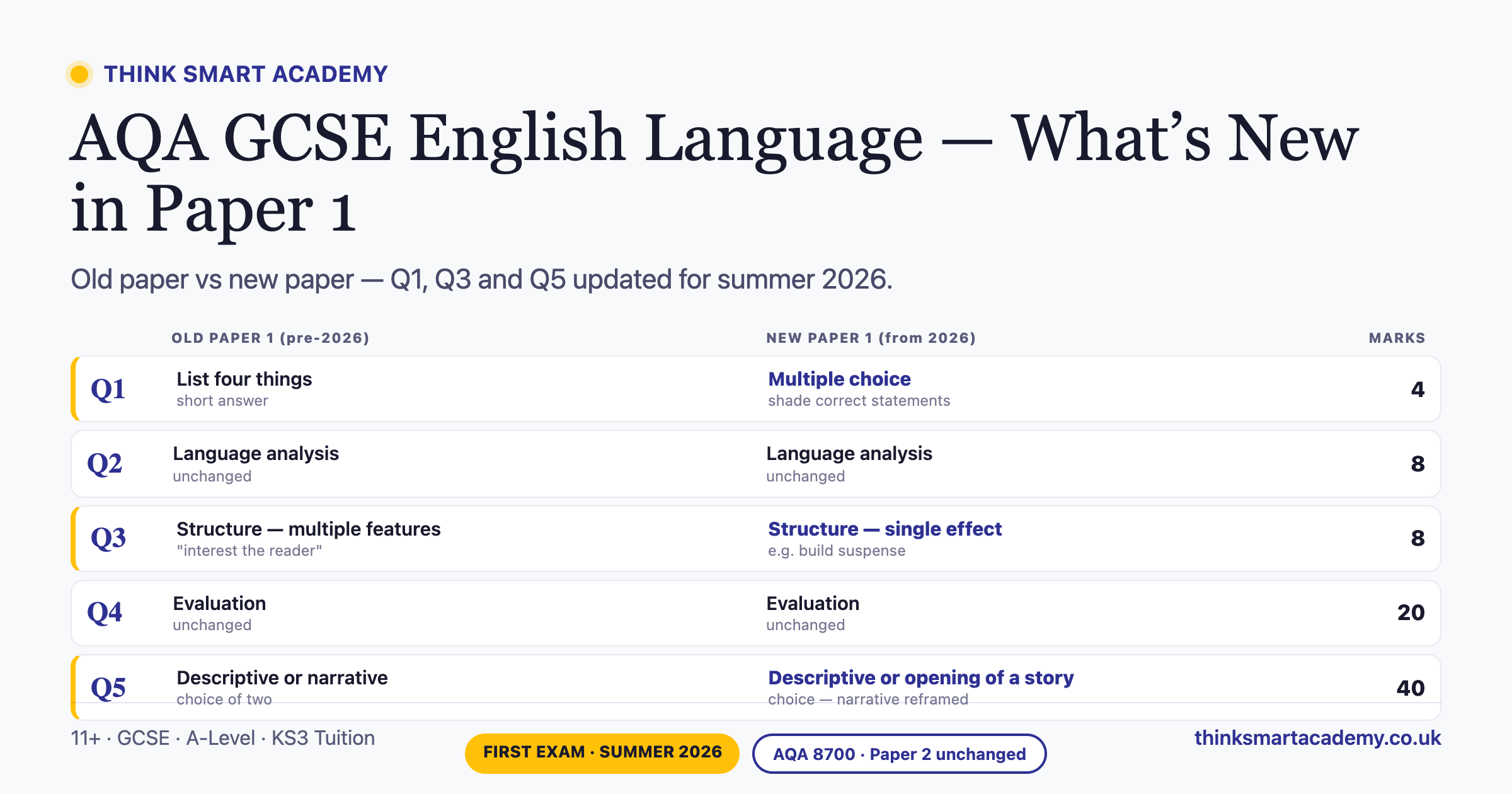
The short version: AQA has updated GCSE English Language Paper 1 (specification 8700) for the summer 2026 series. Question 1 is now multiple choice, Question 3 now focuses on a single structural effect, and the narrative option at Question 5 now asks for the opening of a story. Mark allocations per question are unchanged. The changes affect AQA candidates only, Edexcel and OCR papers are unchanged. Paper 2 is unaffected.
Summer 2026 is the first cohort to sit the updated AQA GCSE English Language Paper 1. If your child is in Year 11 studying AQA 8700, these are the changes you need to understand. If they are sitting Edexcel or OCR, this article is not relevant, skip to our GCSE English Language guide instead.
Book a Free Trial to see how our small-group GCSE English tuition helps students adapt to the new Paper 1 format.
AQA GCSE English Language 2026: Old Paper vs New Paper
Here is the side-by-side comparison most parents are looking for first.
| Question | Old Paper 1 (pre-2026) | New Paper 1 (from 2026) | Marks |
|---|---|---|---|
| Q1 | Short-answer: list four things about… | Multiple choice, shade the correct statements | 4 |
| Q2 | Language analysis | Language analysis (unchanged) | 8 |
| Q3 | Structural analysis, multiple features | Single structural effect, focused response on one effect | 8 |
| Q4 | Evaluation of a statement | Evaluation of a statement (unchanged) | 20 |
| Q5 | Descriptive or narrative writing (choice of two) | Descriptive or narrative writing (choice of two), narrative option now asks for the opening of a story | 40 |
The paper is still 1 hour 45 minutes, still 80 marks, and still worth 50% of the overall GCSE English Language grade. Mark allocations per question have not changed, only the wording and format of Q1, Q3, and the Q5 narrative option.
What Exactly Has Changed
Question 1, Now Multiple Choice
The old Question 1 asked students to “list four things” they could infer from a short section of the source text. It was a low-tariff question (4 marks) that tripped up more students than it should have, because candidates would paraphrase the text inaccurately or stray beyond the lines specified.
The new Question 1 is multiple choice. Students are given a set of statements and shade the correct ones based on the extract. It is still 4 marks, still focused on comprehension, but the format removes the risk of a student losing marks for sloppy paraphrasing.
What this means in practice: Q1 is now a faster, more predictable mark pickup. Careful reading matters more than phrasing.
Question 3, A Single Structural Effect
The old Question 3 was the question most students dreaded. It asked candidates to analyse how the writer had structured the text to “interest you as a reader”, which meant identifying several structural features (openings, shifts in focus, endings, patterns) and explaining each one’s effect.
The new Question 3 is still worth 8 marks but the wording has narrowed: it now asks how the writer has structured the text to create a specific effect, for example, to create suspense, or to build tension. Instead of scattering points across multiple features, candidates focus on how the structure delivers one named effect.
What this means in practice: less breadth, more depth. Students who previously tried to cover four or five unrelated features now need to pick the ones that genuinely serve the effect named in the question and sustain the analysis. This suits students who read closely and can build an argument.
Question 5, Opening of a Story
Under the old paper, Q5 gave candidates a choice: write a description inspired by a picture, or write a narrative. Many students defaulted to description because it felt safer.
Q5 still offers a choice between descriptive and narrative writing, and it is still worth 40 marks (24 for content and organisation, 16 for technical accuracy). The change is to the narrative option: candidates are now asked to write the opening of a story rather than a full narrative. The descriptive option remains picture-based.
What this means in practice: for students who pick the narrative route, the brief is tighter than it used to be. A strong opening, hook, voice, sensory detail, the promise of tension, is what matters. Students need to establish character, setting, or conflict quickly, without trying to finish a plot in 45 minutes.
Why AQA Made These Changes
AQA has not published a single press release explaining every change, but the pattern is clear from the specification update and wider Ofqual commentary.
1. Reduce marking inconsistency. Multiple choice at Q1 removes marker judgement on Q1 paraphrasing. Narrowing Q3 to a single named effect makes marking more reliable, examiners are no longer weighing whether a scatter of loosely related structural points collectively deserves the top band.
2. Align better with Key Stage 3 skills. The changes map more cleanly onto what students practise in Years 7 to 9: careful reading, focused analysis, narrative craft. The old Q3 in particular required a set of structural analysis skills that most Year 9 students had not yet mastered.
3. Reduce the marking burden. Ofqual has raised concerns about examiner supply and marker consistency across GCSE subjects. Simpler question formats are faster to mark reliably, which supports the wider exam system.
AQA’s specification 8700 page (aqa.org.uk/subjects/english/gcse/english-language-8700) is the definitive source for the updated paper. Ask your child’s school for the updated specimen papers if they have not yet been issued.
What This Means for Students Sitting Summer 2026
Practical implications for the first cohort to sit the updated paper:
- Past papers from 2023-2025 are partially out of date. Q2 and Q4 past papers are still useful, those questions are unchanged. Q1, Q3, and Q5 past papers need to be replaced with AQA’s new specimen material.
- Mock results from autumn 2025 may be misleading. If your child’s school set a pre-2026 paper as a mock, the Q1/Q3/Q5 marks do not reflect their likely performance in summer.
- Exam technique has shifted. Less breadth, more depth. Students who did well under the old Q3 by scattering bullet points now need to sustain a longer analytical response.
- Narrative writing has become the dominant creative skill. Students who leaned on descriptive writing at Q5 need to build narrative technique, hooks, voice, character, tension.
- Paper 2 is unchanged. Paper 2 (non-fiction, writers’ viewpoints and perspectives) uses the same structure as previous years. Revision there is business as usual.
How Parents Can Help
You do not need to teach English Language yourself. You do need to make sure the household is aware of what has changed and that the study materials your child is using are current.
- Check the specification date. If your child is using a revision guide or past paper pack printed before 2025, some of the Q1, Q3, and Q5 material will be out of date. CGP, Pearson, and Oxford University Press have all issued updated editions.
- Ask the school for the new specimen papers. AQA published updated sample assessment materials (SAMs 2 and SAMs 3) in November 2025, available to schools via AQA’s Centre Services portal. Your child’s English teacher should have them. If they do not, email and ask.
- Encourage focused practice on Q3 and Q5. These are the two questions where technique has changed most. Fifteen minutes a day of focused practice on structural analysis or story openings is worth more than a weekly two-hour cram session.
- Read fiction together. Narrative craft is learned by exposure. Short stories, Kate Chopin, Roald Dahl, Daphne du Maurier, work well because they model how a story opens.
- Do not panic. The total marks, timing, and 50/50 split with Paper 2 are unchanged. The grade your child would have earned under the old paper is broadly the grade they will earn under the new one.
How Think Smart Academy Is Preparing Students
Our GCSE English tutors rebuilt our Paper 1 scheme of work in autumn 2025 to match the updated specification. Every current Year 11 student studying AQA English Language at Think Smart Academy has been working with the new Q1, Q3, and Q5 formats since September.
Our approach:
- Small groups of 6 to 8, students get individual feedback on Q5 story openings, which only works in a small group setting
- Weekly assessed practice, one full Paper 1 section per week, marked against AQA’s new mark scheme
- Specimen papers only, we have retired pre-2026 Q1/Q3/Q5 material from active use
- Narrative workshops, a dedicated block on story openings, including voice, hook techniques, and building tension in 500 words
- From £15 per hour across both our Slough and High Wycombe centres
If your child is preparing for summer 2026 AQA GCSE English Language, book a free trial and we will show you the updated scheme of work. Online sessions are available nationally on the same small-group model.
Practice Resources
Useful next steps for parents who want to go further:
- Past papers library, downloadable AQA Paper 1 and Paper 2 past papers
- GCSE English Language Explained, full overview of the qualification and grading
- GCSE Revision Timetable 2026, a twelve-week plan for the run-in to summer
- AQA specification 8700, official specification page
- Ofqual, regulator guidance
- JCQ, exam board body for date confirmation
Frequently Asked Questions
Which exam boards are affected by the 2026 English Language changes?
Only AQA. The changes apply to specification 8700 only. Edexcel (Pearson) GCSE English Language and OCR GCSE English Language are unchanged for summer 2026. If your child’s school has not confirmed the exam board, ask the Head of English, it is almost always AQA in Slough and Buckinghamshire state schools, but not universally.
Does this affect Paper 2?
No. AQA GCSE English Language Paper 2 (Writers’ Viewpoints and Perspectives) is unchanged for 2026. The same question structure, mark allocation, and timing apply. Revision strategies for Paper 2 do not need adjustment.
Are grade boundaries expected to change?
Grade boundaries will be set based on the cohort’s performance in summer 2026 as normal. Ofqual has signalled continued post-pandemic stability, with 2025 boundaries showing 21.8% of entries at grade 7 or above and 67.1% at grade 4 or above across all GCSE subjects. Boundaries for the updated Paper 1 may shift slightly in the first year as examiners calibrate, but large swings are unlikely. See our GCSE Grade Boundaries 2026 article for historical data.
Will predicted grades change?
Possibly, in the short term. If your child’s predicted grade was based on mocks using the old Paper 1 format, the school may revise the prediction after the first mock using the new format. This is normal and not a cause for alarm, predicted grades always fluctuate through Year 11.
What about coursework or non-examined assessment?
GCSE English Language has no coursework or NEA that contributes to the final grade. The Spoken Language Endorsement is reported separately as Pass, Merit, or Distinction and is unaffected by the 2026 changes.
How can my child prepare for the new Paper 1?
Focus on the three changed questions: Q1 (careful reading for multiple choice), Q3 (depth over breadth on structural analysis), and Q5 (narrative writing, story openings specifically). Use AQA’s new specimen papers rather than pre-2026 past papers for these three questions. Work with an English teacher or tutor who has seen the updated mark scheme.
Are mock papers available for the new specification?
Yes. AQA published updated sample assessment materials (SAMs 2 and SAMs 3) in November 2025, available to schools via Centre Services. Many schools set these as autumn 2025 or spring 2026 mocks. Commercial revision publishers, CGP, Pearson Revise, Oxford, have issued updated editions with practice papers in the new format.
Does this affect iGCSE English Language?
No. iGCSE (International GCSE) English Language is a different qualification, offered by Pearson Edexcel and Cambridge. It is not affected by the AQA 8700 specification update. If your child is at an independent school sitting iGCSE, these changes do not apply.
Does this affect GCSE English Literature?
No. GCSE English Literature (AQA specification 8702) is unchanged for 2026. The updates are limited to English Language Paper 1.
Exam Timetable Reminder
GCSE English Language Paper 1 for summer 2026 is scheduled in the main exam window (mid-May to mid-June). Exact dates vary by centre, confirm with your child’s school’s exam officer. See our GCSE Exam Timetable 2026 for the full summer series schedule.
Results day is Thursday 20 August 2026. Boundaries, review of marking deadlines, and November resit options are covered in our GCSE Results Day 2026 guide.
Book a Free Trial
If your child is sitting AQA GCSE English Language in summer 2026, the changes to Paper 1 are manageable with the right preparation. Our small-group English tutors at our Slough and High Wycombe centres have rebuilt the scheme of work around the updated specification. Online tuition is available nationally.
- Book a free trial lesson, Contact us to arrange a session at a time that suits you
- Book a free consultation, a 20-minute diagnostic conversation with one of our GCSE English tutors, no obligation
- Slough centre, 01753 531 818
- High Wycombe centre, 01494 506 281
See our full GCSE tuition programme for subject coverage, pricing from £15 per hour, and centre timetables.
Information reflects AQA specification 8700 for first assessment in summer 2026, Ofqual guidance, and JCQ arrangements as of April 2026. Confirm specific exam arrangements with your child’s school.