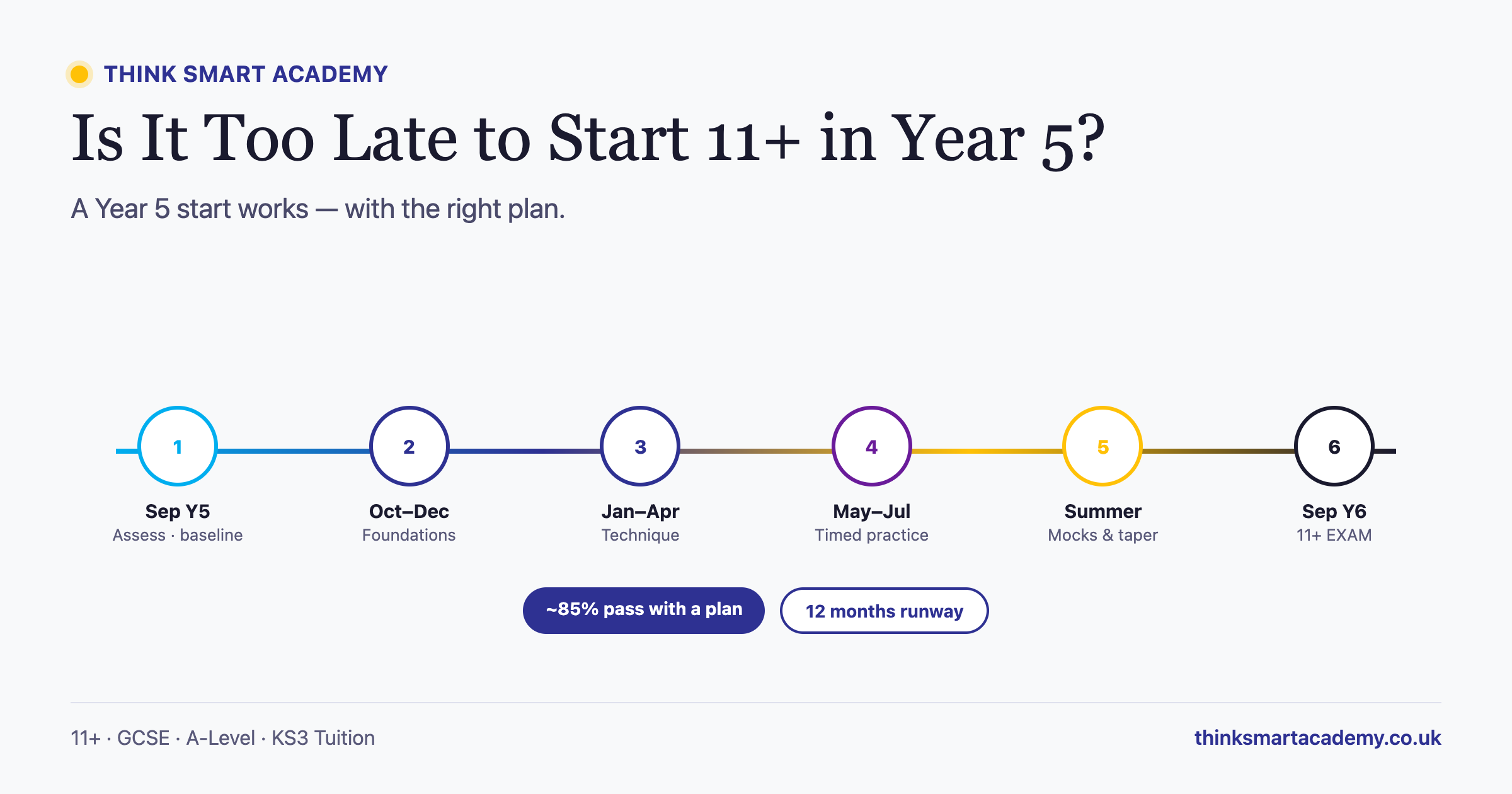
No, it is not too late to start 11+ preparation in Year 5. If your child is working at or around age-expected level, you have enough runway to be ready for the September 2026 exams. What you don’t have is time to drift. A Year 5 start works. A Year 5 start without a plan, a proper assessment, and consistent weekly work does not.
Why parents ask this question
Most parents who call us with this question have just found out that another parent at the school gates started tutoring in Year 3. Or they have read a forum thread claiming 18 months is the bare minimum. Or they have only recently decided that grammar school is the right goal, and the timeline suddenly feels terrifying.
That panic is normal. It is also the single biggest threat to your child’s chances.
Over the past 10 years at Think Smart Academy, we have placed more than 1,000 students into grammar schools across Slough and Buckinghamshire. We have an 85% 11+ pass rate. A good chunk of those children started in Year 5. Some started later than that. What separates the ones who made it from the ones who did not was rarely how early they began. It was how clearly the family assessed the starting point, and how consistently they worked from there.
The real problem with starting late isn’t time. It’s panic. Panic leads to over-tutoring, family rows, tears at the kitchen table, and a child who ends up dreading the exam months before they sit it. Start from a calm place. You have more time than you think.
What you can actually achieve starting in Year 5
Your chances depend less on the month you start and more on two things: your child’s current ability, and how disciplined the preparation is. Here is a realistic view of what each Year 5 start point looks like.
| Start point | Time to exam | Realistic outcome |
|---|---|---|
| Start of Year 5 (Sep 2025) | 12 months | Strong chance if child is at age-expected level. Full coverage of all four subjects, multiple mock rounds, exam technique locked in. |
| Middle of Year 5 (Jan 2026) | 8–9 months | Viable for able children. Some topics covered fast. Less room for mistakes but still enough to pass. |
| Easter of Year 5 (Apr 2026) | 5–6 months | Crash-plan territory. Doable if child reads well and has solid maths. Requires intensive weekly sessions and a summer course. |
| Summer before Year 6 (Jul 2026) | 6–8 weeks | High risk. Suitable only for children already performing well above age expectation with prior exposure to reasoning questions. |
The Slough Consortium exam sits in mid-September 2026, and the Buckinghamshire Secondary Transfer Test is on Thursday 10 September 2026, according to Buckinghamshire Council. Registration windows are tight: Slough Consortium opens 1 May 2026 and closes 5 June 2026, and Bucks opens 1 May 2026 and closes 2 June 2026 for children not already in a Bucks state primary. Miss those windows and the rest of this article doesn’t matter.
The 6-month crash plan (starting summer of Year 5)
If you are reading this in April or May 2026 with a Year 5 child and no prep done, you have a narrow window. Here is what the six months should actually look like.
Weeks 1–2: diagnostic assessment. A proper assessment in all four areas (verbal reasoning, non-verbal reasoning, maths, English) tells you exactly where the gaps are. Without this, you waste the next five months guessing.
Weeks 3–10 (May to early July): focused skill-building. Four to five hours a week of tuition plus two to three hours of independent practice. Prioritise the weakest subject. Master times tables to 12x12. Build vocabulary daily. Learn the core verbal and non-verbal reasoning question types.
Weeks 11–14 (summer course): this is the make-or-break block. A two to three-week summer intensive covers ground that would take months in term-time. TSA runs summer courses specifically timed for this. See our 11+ Summer Courses 2026 guide for details.
Weeks 15–22 (late July to early September): mock exams every week, timed. Score analysis. Targeted revision on weak areas. By the final fortnight, your child should be consistently scoring within the pass range. See mock tests in Slough.
Can it work? Yes, and we see it work every year. But six months demands more of the family than twelve months does. Everyone needs to commit.
The 12-month plan (starting start of Year 5)
This is the ideal Year 5 timeline. Twelve months lets you build properly rather than sprint.
Months 1–3 (autumn term Year 5): assessment and foundation. Establish the weekly routine. Work on times tables, vocabulary, comprehension stamina. Introduce all four 11+ subject areas.
Months 4–6 (winter term into spring): skill development. Work through full question sets. Begin timed practice. Start short mini-assessments every fortnight to track progress.
Months 7–9 (spring to early summer Year 5): mock exams begin. Full papers every two to three weeks under exam conditions. Focus shifts from learning content to applying it. Refine technique.
Months 10–12 (summer and start of Year 6): summer intensive course, final mock rounds, exam-day logistics. Taper intensity in the final fortnight.
A child who starts in the autumn of Year 5 at age-expected level, works four to six hours a week, sits regular mocks, and has a good summer block is genuinely well prepared by September.
What matters most with limited time
When the clock is tight, priorities change. You cannot do everything. Focus ruthlessly on what moves the needle.
| Priority | Why it matters | Time to see impact |
|---|---|---|
| Vocabulary | Largest determinant of verbal reasoning and English scores | 3–4 months of daily work |
| Times tables to 12x12 | Unlocks maths speed. Without this, maths paper is unfinishable | 6–8 weeks if done daily |
| Comprehension stamina | Ability to focus on a long passage and extract meaning | 3–6 months of regular reading |
| Exam technique | Pacing, skipping hard questions, when to guess | Rapid. Can be taught in weeks |
| Non-verbal reasoning | Learnable through pattern exposure | 2–3 months of regular practice |
Drop everything else. Ignore niche question types until the core is solid. Don’t waste time on things that move slowly when you have months, not years.
Red flags that mean it might genuinely be too late
We would be lying if we said every Year 5 start works. Be honest about these signs.
- Your child is more than 18 months behind age-expected in reading or maths. Closing that kind of gap while also learning new 11+ skills is too much in twelve months, let alone six.
- Your child actively resists sitting down to work. Forcing the process rarely ends well. An unwilling child will not engage, and the stress damages more than grammar school gain is worth.
- You have 8 weeks or less and no prep has been done. At that point, the honest conversation is about 12+ entry, strong comprehensive options, or sixth-form grammar entry at 16.
- The grammar school idea is entirely parent-driven. If your child has no buy-in, the result is predictable.
None of these are verdicts on your child’s intelligence. They are practical calls about this specific exam on this specific timeline. Failed the 11+? Here’s what to do next covers the alternative paths properly.
What TSA sees with late starters
Over 10 years preparing students in Slough and High Wycombe, we have noticed clear patterns with children who start in Year 5.
The ones who pass almost always have three things in common. First, they read a lot already, or their parents make them read daily from the start of prep. Second, their parents handle the pressure. They don’t interrogate their child after every mock. Third, the child actually wants a grammar school place. Not desperately, but enough that they don’t fight every session.
The ones who don’t pass often started just as capable. What went wrong was usually preparation that was too scattergun, inconsistent attendance at sessions, or a family where the pressure turned the child off the whole idea by June. We watch this happen every year.
One pattern worth naming: children who join us in January of Year 5 and stay consistent through the summer outperform children who started in September of Year 5 but skipped sessions. Consistency beats head start.
How to accelerate progress
If you are starting late and need to catch up fast, here is what actually works.
Small-group tuition with weekly mocks. Group sessions at TSA (6 to 8 children per class) provide structure, peer competition, and built-in exam-style pressure. Our 11+ courses start at £150/month. That is significantly less than one-to-one but with more exam-realism than home prep. For a full comparison, see group tuition vs private tutoring.
Daily reading, no exceptions. Twenty to thirty minutes, every day. Any genre, any format. This is the single highest-leverage activity for an 11+ child and costs nothing.
One-to-one sessions for specific weak spots. If your child has one clear weakness, a handful of targeted 1:1 sessions will close it faster than trying to cover it in group class.
Summer intensive course. Two to three focused weeks during the holidays are worth months of term-time drift. Our summer courses are designed specifically around the Slough Consortium and Bucks exam formats.
Weekly mock exams from July onwards. This is non-negotiable. Your child needs to know what a full paper feels like before exam day. Book a mock exam.
Register on time. We have had parents call in August panicking because they missed the registration window. We can’t fix that. Slough closes 5 June 2026. Bucks closes 2 June 2026. Put it in your calendar now. More detail on registration in our 11+ Registration 2027 guide.
Definitions
The 11+ consortium exam is a shared entrance test taken by children in Year 6 at partnering grammar schools. The Slough Consortium covers Herschel, Langley, St Bernard’s Catholic, and Upton Court grammar schools, and uses tests produced by CEM. Children need a standardised score of 111 or above.
GL Assessment is one of the two main 11+ test providers. The Bucks Secondary Transfer Test is GL-style, covering verbal reasoning, non-verbal reasoning, English, and maths. The Bucks qualifying score is 121.
A standardised score is an age-adjusted figure that accounts for the fact that summer-born children are younger than their classmates. Raw marks are adjusted so every child is compared on equal footing.
Frequently asked questions
Is 6 months enough time to prepare for the 11+?
Six months is enough if your child is already at or above age-expected level in reading and maths, and the family commits to consistent weekly work plus a summer course. It is not enough for a child who is significantly behind or who resists practice. A diagnostic assessment in week one tells you which category you are in.
How many hours a week should my child study for the 11+ in Year 5?
Four to six hours a week is the right range for Year 5, split across tutoring sessions and short daily practice. Less than three hours a week makes steady progress difficult. More than eight hours a week tends to burn children out, especially late in the run-up to September. Short, regular sessions beat long weekend blocks.
What does 11+ tuition cost in Slough and High Wycombe?
TSA 11+ group tuition starts from £150 per month, which covers weekly sessions, mock exams, and access to our practice materials. Private one-to-one tutoring typically runs £30–£50 per hour in Slough and £40–£50 per hour in Buckinghamshire. Most families find that small-group tuition, combined with a summer course, is the most cost-effective way to prepare. See our full cost breakdown.
What if my child is not ready by September?
Some children genuinely aren’t, and that’s fine. If the mocks in August are consistently well below the pass mark, the honest move is to regroup rather than push through. Excellent comprehensive options exist in both Slough and High Wycombe. 12+ and sixth-form grammar entry at 16 are real routes. Grammar school at 11 is one path among several.
When are the 2026 11+ exams in Slough and Bucks?
The Slough Consortium exam is held in mid-September 2026, with results in mid-October. The Buckinghamshire Secondary Transfer Test is on Thursday 10 September 2026, with results on Friday 9 October 2026. Registration for both opens 1 May 2026 and closes in early June. Our 11+ Registration 2027 guide has the full timeline.
Can my child pass the 11+ without a tutor?
Some do. Most don’t. The subjects tested, particularly verbal reasoning and non-verbal reasoning, are not taught in primary school. Unless you have time to learn the material yourself and teach it consistently, some form of structured support (group tuition, online platform, or private tutor) is almost always worth the investment, especially with a Year 5 start.
Book a free consultation
If you have read this far, you are already taking this seriously. The next step is a proper conversation about your child’s starting point.
We offer free 30-minute consultations at both our Slough and High Wycombe centres. During the consultation, we assess where your child is across all four 11+ areas, tell you honestly whether the timeline is realistic, and build a plan around your child. No pressure, no upsell.
Book a Free Consultation or call us:
- Slough: 01753 531 818
- High Wycombe: 01494 506 281
Starting in Year 5 is not starting late. It’s starting now. That is enough. What matters is whether the next few months are planned, calm, and consistent, or rushed, panicked, and scattered. We can help with the first. The second, we can’t fix for anyone.